The right knee brace depends on more than how firmly it holds your leg. A straight immobilizer limits bending, while a hinged brace may let you adjust the range of motion as recovery progresses.
These 10 options include both styles. Use your clinician’s instructions to narrow the choice, then check length, sizing, and ease of adjustment before you buy.
Best 10 Adjustable Knee Immobilizer Picks for 2026
Best Telescoping Fit
Breg T Scope Premier Post-Op Brace
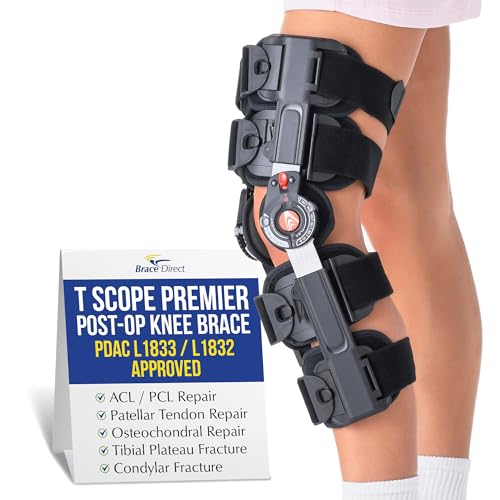
- 17–27-inch telescoping frame
- Adjustable ROM hinge
- Fits thighs up to 30.5 inches
Best For: Post-op support with adjustable length and controlled motion
Best Wide-Thigh Fit

- Fits thighs up to 35 inches
- 0°–120° motion settings
- Padded, bilateral design
Best For: Controlled post-op motion with a wider stated thigh fit
Best Short Panel Brace
Alpha Medical 14-Inch Immobilizer

- 14-inch, three-panel design
- Repositionable side panels
- Fits either knee
Best For: Shorter fixed-support knee immobilization
Best Removable Side Panels
United Ortho 16-Inch Immobilizer

- Removable, adjustable side panels
- Four straps on a 16-inch brace
- Fits circumferences up to 29 inches
Best For: Fixed immobilization with repositionable side support
Convertible Support

- 0°–120° adjustable motion
- Removable side hinges
- Open patella and back
Best For: Small-size hinged support with adjustable motion
Three-Panel Immobilization
Alpha Medical 16-Inch Knee Immobilizer
- Adjustable three-panel fit
- Hook-and-loop straps
- Fits either knee
Best For: Traditional post-injury or post-operative immobilization
Shoulder-Strap Option
Upgraded Hinged ROM Knee Brace, Large

- Listed with shoulder strap
- 0°–120° adjustable motion
- Removable side hinges
Best For: Large-size hinged support with shoulder-strap option
Removable-Hinge Pick
ROM Brace for Recovery and Sports

- 0°–120° adjustable motion
- Removable side hinges and dials
- Open patella design
Best For: Recovery support with a later sports-brace option
Post-Op Fit Pick
Length-Adjustable ROM Knee Brace

- 18–26.4-inch adjustable length
- 10° motion-setting increments
- Quick-release buckles
Best For: Post-op support with adjustable fit and motion
Straight-Leg Pick

- Four straight-leg aluminum stays
- Three-panel, five-strap fit
- Breathable, moisture-wicking fabric
Best For: Recovery plans requiring a straight knee
Best Telescoping Fit – Breg T Scope Premier Post-Op Brace
If you need an adjustable knee immobilizer for post-surgical support but also need controlled movement as recovery progresses, the Breg T Scope Premier offers an adjustable range-of-motion hinge. Its telescoping frame extends from 17 to 27 inches and fits thighs up to 30.5 inches around.
Best For: Post-op users who need adjustable brace length and clinician-directed range-of-motion settings.
Pros:
- Telescoping frame accommodates different leg lengths.
- Adjustable hinge supports customized motion settings.
- Quick-clip buckles simplify application.
Cons:
- Not intended for thighs over 30.5 inches around.
- A hinged ROM brace may be more than you need if you only want a simple fixed immobilizer.
This is a practical choice when fit adjustability and controlled knee motion matter more than the simplicity of a fixed-panel brace.
Best Wide-Thigh Fit – KD ROM Hinged Knee Brace
The KD ROM is worth considering if you’re shopping for an adjustable knee immobilizer but your recovery plan calls for controlled bending rather than fixed straight-leg support. Its hinges adjust flexion and extension from 0° to 120°, and its straps fit thighs up to 35 inches around.
Best For: Adults seeking a bilateral post-op ROM brace with a wider stated thigh fit.
Pros:
- Quick-lock motion settings accommodate different recovery stages.
- Soft, breathable lining and padding help reduce pressure during wear.
- Fast-clip buckles and adjustable straps simplify fitting.
- Works on either leg.
Cons:
- It is a hinged motion-control brace, not a basic three-panel immobilizer.
- The product notes suggest a shoulder strap to help reduce slipping, so fit may require extra attention.
Its standout advantage is the combination of a 35-inch thigh limit and adjustable motion; confirm your prescribed settings before use.
Best Short Panel Brace – Alpha Medical 14-Inch Immobilizer
For a straightforward adjustable knee immobilizer, this 14-inch Alpha Medical brace uses three panels with repositionable side panels to tailor the fit. Breathable foam with a cotton liner and hook-and-loop straps round out its simple, bilateral design.
Best For: Adults seeking a shorter, fixed-support immobilizer for either knee.
Pros:
- Adjustable side panels allow an individualized fit.
- Three-panel construction is designed for knee immobilization.
- Can be worn on the left or right knee.
- Breathable foam and cotton lining support comfort during extended wear.
Cons:
- Fixed immobilization does not offer adjustable bending settings.
- The 14-inch length may not suit someone prescribed a longer brace.
Choose this model when your priority is adjustable panel placement in a short immobilizer rather than a hinged recovery brace.
Best Removable Side Panels – United Ortho 16-Inch Immobilizer
The United Ortho 61016 is an adjustable knee immobilizer for buyers who want a 16-inch brace with removable side panels. It combines a lightweight rigid posterior stay with adjustable medial and lateral stays, plus four straps for securing the fit.
Best For: Knee or leg immobilization when adjustable panel placement and a 16-inch length are appropriate.
Pros:
- Removable side panels can be positioned for an individualized fit.
- Four adjustable straps secure the 16-inch brace.
- Designed for either the right or left leg.
- Universal circumference fits up to 29 inches.
Cons:
- Not suitable for circumferences over its stated 29-inch limit.
- No adjustable range-of-motion hinge is listed.
This is a sensible fixed-support option if its length and circumference match your needs and you prefer adjustable stays over hinged motion control.
Convertible Support – Hinged ROM Knee Brace, Small
This adjustable knee immobilizer offers dial-controlled motion from 0° to 120° for rehabilitation plans that call for controlled bending. Its removable side hinges also make it a flexible choice if you want to use the brace for sports support after recovery.
Best For: Adults seeking a small, hinged brace with adjustable range of motion and removable stabilizers.
Pros:
- Locking dials adjust the range of motion from 0° to 120°.
- Both side stabilizers can be removed.
- Open patella and back design; fits the left or right knee.
Cons:
- Small size may not suit every leg; check sizing before ordering.
- Hand wash only.
Choose this model when adjustable motion and a convertible design matter more than a traditional three-panel immobilizer. Follow your clinician’s guidance on the appropriate motion setting.
Three-Panel Immobilization – Alpha Medical 16-Inch Knee Immobilizer
This adjustable knee immobilizer uses a 16-inch, three-panel design with movable side panels for a customized fit. Hook-and-loop straps make it straightforward to apply when knee immobilization is needed after an injury or surgery.
Best For: Adults looking for a traditional, adjustable three-panel brace for post-injury or post-operative knee immobilization.
Pros:
- Adjustable side panels help tailor the fit.
- Hook-and-loop straps allow easy application and adjustment.
- Lightweight, breathable construction can be worn on either knee.
Cons:
- The 16-inch length should be checked against your fit requirements.
- Hand wash only.
This is the more conventional immobilization option in the group, rather than a hinged brace with selectable bending angles. Confirm the required brace length and use with your care provider.
Shoulder-Strap Option – Upgraded Hinged ROM Knee Brace, Large
This adjustable knee immobilizer pairs side stabilizers with locking dials that set the range of motion from 0° to 120°. The large, upgraded version is listed with a shoulder strap, distinguishing it from the basic hinged model.
Best For: Adults seeking a large hinged brace with adjustable motion and the upgraded shoulder-strap configuration.
Pros:
- Locking dials provide a 0°–120° motion setting.
- Removable side hinges allow a switch to sports-brace use after recovery.
- Open patella and back design; suitable for either knee.
Cons:
- The large size may not fit every wearer; check sizing.
- Adjustable motion is not a substitute for clinician-directed immobilization settings.
Pick this version if you want the listed shoulder-strap upgrade alongside controlled-motion hinges. Confirm whether your recovery plan calls for a hinged brace and which motion setting to use.
Removable-Hinge Pick – ROM Brace for Recovery and Sports
This adjustable knee immobilizer offers dial-controlled motion from 0° to 120° and side stabilizers for knee support during rehabilitation. Its distinguishing feature is that the hinges and locking dials can be removed for use as a sports knee brace after recovery.
Best For: Adults who want adjustable motion support during recovery and a brace they can later use for sports protection.
Pros:
- Side hinges and locking dials adjust the range of motion from 0° to 120°.
- Removable hinges and dials provide a second, sports-brace configuration.
- Open patella and back design reduces pressure around the kneecap.
Cons:
- The listed product is size L, so check sizing before ordering.
- Hand wash only.
Choose this one if removable hardware matters as much as controlled motion. Confirm the prescribed motion settings with your clinician before using it for rehabilitation.
Post-Op Fit Pick – Length-Adjustable ROM Knee Brace
This adjustable knee immobilizer is built around post-surgical support, with a hinged range-of-motion dial and an expandable 18–26.4-inch length. Quick-release buckles make it easier to remove and put back on after the first fitting.
Best For: Adults seeking a post-op brace with adjustable length and controlled flexion and extension.
Pros:
- Motion settings adjust in 10° increments, with 0°–120° flexion and 0°–90° extension ranges.
- Expandable length and adjustable straps accommodate a range of adult leg sizes.
- Quick-release buckles simplify repeat removal and wear after initial adjustment.
Cons:
- Its stated fit limits still require measuring: up to 31.5 inches at the upper thigh and 20 inches at the lower leg.
- Initial strap and buckle adjustment is needed before quick-release use.
The detailed fit limits are useful when comparing post-op braces. Measure your leg and follow your clinician’s prescribed motion limits rather than choosing dial settings on your own.
Straight-Leg Pick – Three-Panel Knee Immobilizer
If the goal is to limit knee bending rather than adjust a motion range, this adjustable knee immobilizer takes a different approach. Four aluminum stays hold the leg in a protected straight position, while three panels and five straps let you adjust the fit.
Best For: People directed to keep the knee straight during recovery or injury support.
Pros:
- Four aluminum stays help prevent unwanted knee bending.
- Three panels and five adjustable straps accommodate different leg shapes.
- Breathable, moisture-wicking fabric is intended for extended wear.
Cons:
- Not suited to a recovery plan that calls for dial-adjustable knee flexion.
- The listed size is Large; check the fit before ordering.
This is the more straightforward straight-leg option of the three, not a hinged ROM brace. Check with your clinician that full immobilization matches your recovery instructions.
How We Picked These Adjustable Knee Immobilizers
We focused on the distinctions that matter when comparing the selected products: straight three-panel immobilizers versus hinged range-of-motion (ROM) braces, available lengths, fit adjustments, and how readily you can identify the support each design provides. The list includes 14- and 16-inch three-panel options as well as several post-op hinged braces. We did not treat them as interchangeable: the right choice depends on whether your care plan calls for a straight knee or controlled movement.
Product names alone cannot establish clinical effectiveness, comfort, or build quality. Check the current product listing for measurements and included features, and follow your clinician’s prescribed brace type, fit, and ROM settings.
Quick Comparison: Straight Immobilizer or Hinged Brace?
Three-panel immobilizers, such as the Alpha Medical and United Ortho options, have adjustable side panels intended to help fit the brace around the leg. They are the category to examine when the instruction is to keep the knee straight. Their adjustable panels do not provide an adjustable bending angle.
Hinged ROM braces, including the Breg T Scope Premier, KD ROM, and several other listed options, are designed around adjustable knee-motion control. Compare their stated extension and flexion settings against your prescription rather than assuming every hinge offers the same range or adjustment method. The remaining adjustable brace is worth checking against these two groups before ordering; its name does not establish whether it has a locking hinge.
Key Buying Factors for an Adjustable Knee Immobilizer
Match the Prescribed Motion
First confirm whether you need full extension immobilization, a locked hinged brace, or movement within specified limits. A hinged brace should not be set by guesswork. If your instructions are unclear, ask your care team before choosing or changing settings.
Measure for Fit and Length
Follow each manufacturer’s sizing chart and measurement points; a generic small-to-large label may not tell you enough. Brace length also matters. A 14-inch and a 16-inch immobilizer can cover the leg differently, so check the recommended length and where the brace will sit above and below your knee. Adjustable side panels can help shape the fit, but they cannot make an incorrectly sized brace fit reliably.
Check Everyday Practicality
Look at strap placement, hinge access, and whether you can put the brace on as directed. Confirm that the brace stays positioned when you stand or walk, without assuming that tighter straps are better. If it shifts, rubs, or causes numbness, seek fitting advice rather than continuing to wear it that way.
Who Should Buy Which Adjustable Knee Immobilizer?
Choose a three-panel immobilizer if your instructions call for a straight knee and its length and sizing match your measurements. Choose a hinged ROM brace if your recovery plan specifies adjustable flexion or extension limits; prioritize a model whose settings match those instructions. If you are deciding between similar-looking hinged listings, verify the exact model, size chart, and hinge details instead of relying on a broad product title. When the required brace type is uncertain, get clarification from your clinician before buying.