The Work Back Brace review comes down to one simple question: do you need structured lower-back support for demanding work, not just casual posture help?
For people who lift, bend, drive, or stay on their feet for long shifts, this Work Back Brace is built for exactly that kind of routine.
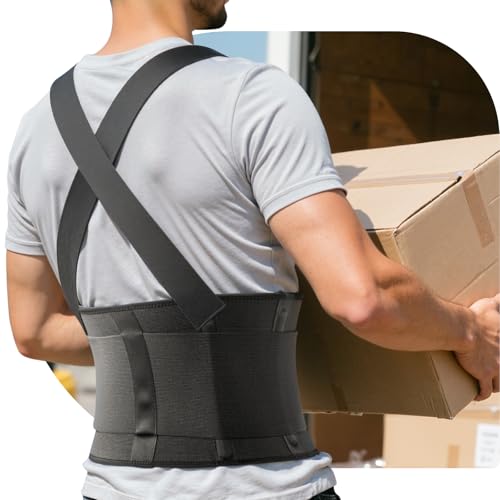
Work Back Brace Review Summary
The Work Back Brace makes sense for buyers who want a supportive, adjustable belt that is aimed at physically demanding days rather than light comfort wear.
Based on the listing, it is meant for construction, warehouse work, landscaping, heavy lifting, driving, and other repetitive-motion tasks where the lower back takes the load.
If your priority is bracing, stability, and usable day-long support, this is the kind of product that fits the job.
It is not presented as a medical device with a clinical claim set, and that matters.
The listing frames it as a support belt with double-pull tension straps, flexible posterior stays, suspenders, and breathable materials.
That combination suggests a brace designed to stay in place while you work, which is more useful than a soft lumbar wrap when the day includes lifting, twisting, and long hours of movement.
The tradeoff is that it is purpose-built: if you want something minimal, invisible, or purely posture-oriented, this is probably more brace than you need.
Review Scorecard
| Category | Score | Why it fits |
|---|---|---|
| Lower-back support | 9/10 | The listing emphasizes substantial support, double-pull tension straps, and posterior stays. |
| Workday stability | 9/10 | Suspenders and adjustable design are meant to keep the brace in place during movement. |
| Comfort for long wear | 8/10 | Breathable material is a strong sign for extended use in warm, active settings. |
| Adjustability | 8/10 | The brace is described as adjustable for different body sizes and work conditions. |
| Pain-relief usefulness | 8/10 | The product is aimed at sciatica, herniated disc discomfort, and general lower-back pain support. |
| Practicality for labor | 9/10 | Construction, warehouse, landscaping, and lifting use cases are directly called out. |
Key Features and Specifications of Work Back Brace
The Work Back Brace is a lower-back support belt marketed for men and women, with a black Large version listed in the product record.
The core idea is straightforward: provide strong lumbar support for work-related strain and keep the brace secure through movement.
The listing highlights several practical design choices:
- Adjustable fit for different body sizes
- Suspenders for added stability
- Double-pull tension straps
- Flexible posterior stays
- Breathable fabric for longer wear
- Support focused on lower back and abdominal areas
The use cases are unusually specific, which is helpful for buyers.
The brace is positioned for construction, warehousing, heavy lifting, landscaping, long driving, office work, and other repetitive-motion jobs.
That list tells you a lot about the intended user: someone whose back takes repeated stress rather than occasional strain.
The product description also frames it as suitable for people dealing with back pain, sciatica, or herniated disc-related discomfort.
That is a meaningful buyer signal, but it should be read as the listing’s intended support claim, not a promise of treatment.
In practical terms, the brace is trying to do three things well: stabilize the lower back, stay secure during movement, and remain wearable through a full shift.
Pros and Cons of Work Back Brace
Pros
- Stronger, more structured support than a basic elastic belt
- Suspenders should help it stay positioned during active work
- Breathable material is better suited to long wear than rigid, hot designs
- Adjustable construction broadens the fit range
- Clear focus on labor, lifting, and repetitive-motion jobs
- Flexible posterior stays add support without making the design look purely rigid
Cons
- It is clearly specialized, so it may feel like too much brace for casual use
- The support-first design may not appeal to buyers who want something discreet
- Listing claims are broad, so buyers should treat pain-relief language as support guidance, not a guarantee
- A brace with suspenders can be more cumbersome than a simpler wrap
Who Should Buy Work Back Brace?
Buy the Work Back Brace if your day involves lifting, bending, carrying, climbing, or standing for long periods and you want lower-back support that is meant to stay put.
It is especially relevant for construction workers, warehouse staff, landscapers, drivers, and anyone who regularly loads the lumbar area.
It is also a sensible choice if you want a brace that feels more structural than soft.
The inclusion of double-pull straps and posterior stays indicates a more serious support setup than a thin comfort sleeve.
For buyers who feel their current belt shifts, bunches, or fails when they move, that stability focus is the main reason to consider this model.
Skip it if you only want light posture support, a subtle under-clothes layer, or a low-profile solution for office-only use.
Also skip it if you want a product that is framed around general wellness rather than jobsite durability.
This is a work brace first and a comfort accessory second.
How Work Back Brace Handles Real-World Use
Stability During Lifting
The brace is designed around keeping the lower back supported while the body is under load.
Double-pull straps and posterior stays suggest a fit that can be tightened to match the task, which matters more when you are lifting repeatedly than when you are standing still.
Comfort Over a Long Shift
Breathable material is one of the most practical details in the listing.
A back brace can provide good support and still fail as a work tool if it traps heat or becomes irritating after a few hours.
Here, the breathable construction is a meaningful advantage for anyone wearing it through a full shift.
Fit and Positioning
The suspenders are the feature that stand out most for retention.
A lot of support belts do the job when you are upright, then slide or rotate when you bend.
Suspenders help address that by anchoring the brace more securely, which is useful for people who move constantly.
Support Scope
The product is described as helping with lower-back pain, sciatica, and herniated disc-related discomfort.
That makes it attractive to buyers with a broader support need, but it still reads like a general support aid rather than a specialized clinical brace.
In other words, it is meant to help you work and move more comfortably, not replace medical care.
Alternatives to Work Back Brace
If you want similar products with a different support style, these are credible Amazon search alternatives:
McDavid is worth checking if you want a sports-and-work crossover approach.
Bauerfeind is a stronger option for buyers who prefer a premium support brand with a more structured reputation.
Vive often shows up for shoppers who want a straightforward brace with broad sizing and easy Amazon availability.
Shock Doctor is another reasonable search if you want a brace style that leans toward firm support rather than light compression.
Is Work Back Brace Worth It?
Yes, if your main need is serious lower-back support for active work and you want a brace that is clearly built around stability, adjustability, and stay-in-place performance.
The Work Back Brace makes the most sense for buyers who lift, move, or stand all day and want a support belt that is more functional than decorative.
It is less compelling if you want something minimalist, subtle, or only mildly supportive.
But for the right buyer, the feature mix is coherent: breathable material, suspenders, double-pull tension, and a design focused on physically demanding use.
If that matches your day, this is worth considering.