Finding the right silverware can make everyday meals easier for people managing hand tremors, arthritis, Parkinson’s disease, or reduced grip strength. The best adaptive designs improve control without making utensils unnecessarily difficult to handle.
We’ve gathered 10 ergonomic adaptive utensils with features such as angled heads, weighted construction, bendable shafts, rotatable joints, and cushioned non-slip handles. Use the guide below to compare designs and choose the most suitable fit.
Best 10 Ergonomic Adaptive Utensils Picks for 2026
Travel-Ready Comfort

- Lightweight foam handles reduce hand strain
- Includes curved rocker knife and four pieces
- Canvas wrap supports portable dining
Best For: Users wanting a lightweight, travel-friendly adaptive set
Custom-Fit Control
Bendable Wide-Grip Utensil Set

- Adjustable fork, tablespoon, and teaspoon
- Wide grips with palm-aligning ribs
- Suitable for right- or left-handed users
Best For: Users who need bendable positioning and broad handles
Everyday Stability
Vive Ribbed-Handle Adaptive Set

- Wide ribbed handles support steadier grip
- Includes fork, spoon, and knife
- Dishwasher safe with a 60-day guarantee
Best For: Everyday meals requiring simple grip and stability support
Best Angled Stability Pick
42° Angled Weighted Utensils Set

- 42° angle reduces wrist rotation
- 2.5-ounce weighted handles aid stability
- Built-up silicone grips improve control
Best For: Right-handed users needing stable everyday adaptive cutlery
Best Adjustable-Grip Set
360° Rotatable Weighted Utensils

- 360° swivel design supports custom positioning
- Adjustable strap helps prevent slips
- Includes spoon, fork, and knife
Best For: Users needing flexible angles and added hand security
Best Complete Four-Piece Set
270° Adjustable Adaptive Cutlery

- 270° bendable neck supports custom angles
- Weighted built-up handles aid grip
- Includes tablespoon and enlarged teaspoon
Best For: Users seeking versatile four-piece dining support
Best Angled Pair
Purple Right-Hand Adaptive Utensils

- Angled spoon and fork reduce wrist turning
- Weighted, textured silicone grips support control
- Dishwasher-safe two-piece set
Best For: Right-handed users needing a simple tremor-support utensil pair
Best Complete Dining Kit

- Includes utensils, dishware, suction mats, and storage wrap
- 45° angled spoon and fork designs
- Weighted, dishwasher-safe stainless steel pieces
Best For: Right-handed users who need a comprehensive daily or travel dining kit
Best Compact Set
KintKita 4-Piece Weighted Utensils
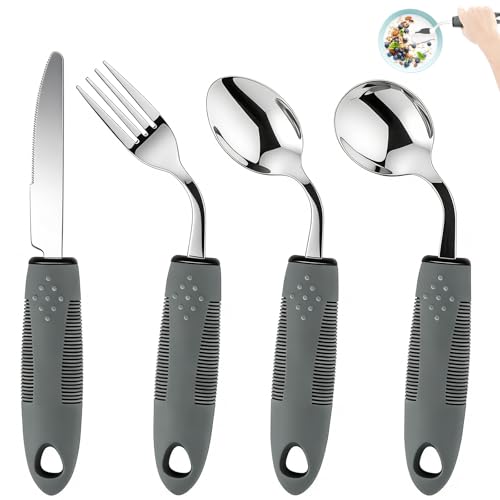
- 45° angled design reduces wrist movement
- 2.5–2.9-ounce weighted pieces support stability
- Textured silicone handles and dishwasher-safe steel
Best For: Right-handed users wanting a compact tremor-support utensil set
Travel-Ready Comfort – BUNMO Foam-Grip Adaptive Set
For shoppers comparing ergonomic adaptive utensils, this BUNMO set emphasizes lightweight handling, soft foam grips, and convenient portability. It includes the core pieces needed for everyday meals, plus a reusable canvas wrap for dining away from home.
Best For: Older adults or users with tremors, weak hand grips, or hand fatigue who want a lightweight set for home and travel.
Pros:
- Soft, cushioned, non-slip foam handles are designed to reduce hand strain.
- Includes a fork, tablespoon, teaspoon, and curved rocker knife.
- Reusable canvas travel wrap keeps the set organized and portable.
- Rust-resistant stainless steel construction and dishwasher-safe care support daily use.
Cons:
- The lightweight design may not suit shoppers specifically seeking weighted utensils.
- The set includes a tablespoon and teaspoon rather than a second standard spoon option.
Choose this set when comfort, simplicity, and discreet portability matter most. The curved rocker knife may also help users cut food without a sawing motion.
Custom-Fit Control – Bendable Wide-Grip Utensil Set
These ergonomic adaptive utensils stand out for their bendable design and wide grip. The fork, tablespoon, and teaspoon can be positioned to match the user’s preferred angle, while the knife handle is shaped for use with either hand.
Best For: People with arthritis, hand tremors, Parkinson’s, or poor grip strength who need adjustable positioning and broad handles.
Pros:
- Fork, tablespoon, and teaspoon can be bent into a preferred position.
- Wide handles and palm-aligning ribs support dexterity and control.
- Designed for both right- and left-handed users.
- Dishwasher safe up to 125 degrees.
Cons:
- The set’s bendable configuration may require adjustment to find the most comfortable angle.
- The supplied details do not specify a storage case or travel wrap.
This is a practical choice for users who benefit from customized utensil angles rather than fixed-handle designs. Its four-piece layout covers common meal needs without adding unnecessary pieces.
Everyday Stability – Vive Ribbed-Handle Adaptive Set
If you want ergonomic adaptive utensils with a straightforward everyday design, the Vive set uses built-up ribbed composite handles to provide a wider, non-slip grip. Its three-piece configuration keeps the selection simple for routine meals.
Best For: Users with arthritis, Parkinson’s, hand tremors, or dexterity challenges who want a basic fork, spoon, and knife set.
Pros:
- Wide, textured handles are contoured for stability and control.
- Includes the three primary pieces for everyday dining.
- Premium stainless steel tips are built for durability.
- Dishwasher safe and backed by a 60-day guarantee.
Cons:
- It includes three pieces, so it lacks the extra teaspoon offered by some sets.
- The supplied details describe non-weighted utensils, which may not meet a preference for weighted designs.
Vive is a sensible option for shoppers who prioritize a familiar utensil lineup and easy cleanup. The ribbed handles add grip support without relying on a heavier utensil body.
Secure Adjustable Support – Weighted Strap Adaptive Utensils
Among ergonomic adaptive utensils, this set combines weighted, textured handles with an adjustable silicone strap. Its flexible neck and 360-degree swivel spoon and fork are intended to reduce wrist movement and help users maintain control during meals.
Best For: Users with hand tremors, Parkinson’s, joint pain, or limited grip stability who may benefit from weight, hand security, and adjustable angles.
Pros:
- Weighted handles and an adjustable strap help reduce slipping and fatigue.
- Flexible angle adjustment can minimize wrist movement and strain.
- Swivel spoon and fork accommodate left- and right-handed users.
- Includes stainless steel spoon, fork, and knife with rounded edges.
Cons:
- The weighted construction may feel less comfortable for users who prefer lightweight utensils.
- The supplied details do not specify dishwasher-safe care.
This set is best suited to shoppers seeking more active hand support than a conventional adaptive handle provides. The strap and adjustable neck offer useful configuration options for home, hospital, or assisted-living use.
Best Angled Stability Pick – 42° Angled Weighted Utensils Set
These ergonomic adaptive utensils combine a 42° angled design with 2.5-ounce weighted handles to help reduce wrist rotation and improve control during meals. Built-up, textured silicone grips make the set a practical option for users with tremors, arthritis, or limited hand mobility.
Best For: Right-handed seniors and adults with Parkinson’s, hand tremors, arthritis, or reduced dexterity who want a stable four-piece everyday set.
Pros:
- Angled design may reduce wrist rotation and fatigue.
- Moderate 2.5-ounce weighting adds stability without being excessively heavy.
- Includes a fork, knife, and soup spoon with large non-slip handles.
- Stainless steel eating surfaces and silicone handles are dishwasher-safe.
Cons:
- This version is specified for right-handed users.
- The set includes three utensil types despite being described as a four-piece set.
Choose this set if a fixed ergonomic angle and moderate weighting are more useful than an adjustable design. Its durable construction and straightforward grip-focused design suit regular daily use.
Best Adjustable-Grip Set – 360° Rotatable Weighted Utensils
For shoppers comparing ergonomic adaptive utensils, this three-piece set stands out for its 360° swivel design and adjustable silicone hand strap. The bendable neck can be positioned for either hand, while the textured weighted handle is designed to improve stability and reduce fatigue.
Best For: Left- or right-handed users with tremors, Parkinson’s, joint pain, or difficulty maintaining a secure utensil grip.
Pros:
- 360° adjustable spoon and fork design accommodates multiple angles.
- Adjustable strap helps secure the utensil to the hand.
- Includes a spoon, fork, and knife for complete meal coverage.
- Rounded stainless steel edges and soft silicone are designed for comfortable use.
Cons:
- Only three pieces are included, compared with some four-piece alternatives.
- The adjustable strap and swivel mechanism may require setup before use.
This is the most flexible option in the group for users who need to change utensil positioning. Its strap adds extra retention, making it particularly useful when grip security is a primary concern.
Best Complete Four-Piece Set – 270° Adjustable Adaptive Cutlery
This ergonomic adaptive utensils set pairs weighted handles with a 270° bendable metal neck, allowing users to adjust the angle for a more comfortable eating position. It also includes both a tablespoon and enlarged teaspoon, giving users more serving flexibility than a basic spoon-and-fork set.
Best For: Adults and seniors with limited grip strength, arthritis, tremors, or reduced hand control who want four versatile pieces for daily meals.
Pros:
- 270° adjustable angle can reduce wrist strain and accommodate different positions.
- Weighted, built-up non-slip handles support control.
- Four-piece set includes fork, knife, tablespoon, and enlarged teaspoon.
- Dishwasher-safe stainless steel construction is suited to daily use.
Cons:
- The metal neck requires manual bending to set the preferred angle.
- Weighted handles may not suit users who prefer very lightweight utensils.
Consider this set when piece count and spoon variety matter as much as adjustability. The enlarged spoon options and broad handle are practical additions for users who need extra support with scooping and gripping.
Best Angled Pair – Purple Right-Hand Adaptive Utensils
These ergonomic adaptive utensils are a focused two-piece option for right-handed users who need easier wrist positioning and more controlled eating. The angled spoon and fork combine a weighted build with textured silicone grips to support independent meals.
Best For: Right-handed adults with hand tremors, Parkinson’s-related wrist limitations, or difficulty gripping standard utensils.
Pros:
- Angled design helps reduce wrist turning and arm bending.
- Weighted construction is intended to improve control without excessive fatigue.
- Food-grade stainless steel heads and non-slip silicone handles.
- Dishwasher safe below 120°C/248°F.
Cons:
- This package includes only one spoon and one fork.
- The listed model is designed for right-handed use.
- Color selection is limited to the chosen variant.
This is a practical pick when the priority is a simple, easy-to-grip spoon-and-fork pair rather than a complete place setting. Its angled profile and moderate weighting address common wrist-control challenges while keeping cleanup straightforward.
Best Complete Dining Kit – 9-Piece Adaptive Utensils Set
This ergonomic adaptive utensils set is built for daily meals, care settings, and travel. Along with angled weighted utensils, it includes dining accessories and a canvas storage wrap for a more comprehensive mealtime setup.
Best For: Right-handed seniors and adults with tremors, arthritis, weak hand grip, stroke recovery needs, or limited hand mobility who want a broader dining kit.
Pros:
- Includes a soup spoon, dinner spoon, fork, rocker knife, and serrated dinner knife.
- Also includes a spill-proof plate, non-slip bowl, two suction mats, and a portable bag.
- 45° angled spoon and fork designs can reduce wrist strain and hand movement.
- Stainless steel utensils and silicone handles are dishwasher safe.
Cons:
- The set is specified for right-handed use.
- Its larger collection may be more than needed for shoppers seeking only utensils.
- The notes describe the pieces as lightweight, while each utensil is weighted to approximately 2.5–2.9 ounces.
Choose this set when adaptive silverware is only part of the support needed at mealtime. The included dishware, suction mats, and travel wrap make it more versatile than a basic utensil pair, particularly for assisted-living or recovery use.
Best Compact Set – KintKita 4-Piece Weighted Utensils
For shoppers seeking a smaller set of ergonomic adaptive utensils, this four-piece option pairs 45° angled spoon and fork designs with weighted, textured silicone handles. It is intended to support steadier, more independent eating without adding a full collection of dishware.
Best For: Right-handed users with Parkinson’s, arthritis, hand tremors, weak grip, or stroke-recovery needs who want a compact utensil set.
Pros:
- 45° angled spoon and fork profiles help minimize wrist movement.
- Each utensil weighs approximately 2.5–2.9 ounces for added stability.
- Oversized textured silicone handles improve traction and control.
- Rust-resistant stainless steel and dishwasher-safe construction.
Cons:
- The set is designated for right-handed use.
- It does not include the plate, bowl, mats, or storage bag described with the larger nine-piece set.
- Added weight may not suit users who prefer very lightweight utensils.
This set offers a middle ground between a two-piece starter pair and a complete dining collection. It is a sensible choice when stability, grip, and easy cleaning matter more than having supplemental dishware.
How We Picked These Ergonomic Adaptive Utensils
We focused on practical features that can affect comfort, control, and independence during meals. The selected sets cover several common approaches, including enlarged foam handles for weak grips, weighted utensils for reducing shaking, angled heads for limited wrist movement, and adjustable or rotatable designs for positioning flexibility.
We also considered the completeness of each set, the inclusion of essential pieces such as a fork, spoon, teaspoon, and knife, and whether the design appears suitable for everyday home use or travel. Individual needs vary, so product details such as weight, angle, handle diameter, and adjustment range should be checked before purchase.
Quick Comparison
| Feature | Best suited to | What to consider |
|---|---|---|
| Soft, enlarged handles | Weak grip or arthritis | Prioritize comfort and handle diameter |
| Weighted utensils | Hand tremors or shaking | More weight can improve stability but may cause fatigue |
| Angled heads | Limited wrist or arm movement | Choose an angle that aligns naturally with the mouth |
| Bendable or adjustable shafts | Personalized positioning needs | Confirm that the mechanism stays secure during use |
| Travel cases or wraps | Dining away from home | Look for compact storage and easy cleaning |
Key Buying Factors for Ergonomic Adaptive Utensils
Weight and Balance
Weighted silverware may help dampen involuntary movement and make the utensil feel steadier. However, heavier is not always better. Someone with limited strength may find a lightweight model easier to lift repeatedly, while another user may benefit from additional mass. If possible, compare the listed weight of each piece and consider the user’s endurance.
Handle Shape and Grip
Look for thick, textured, or foam-covered handles when a narrow standard handle is difficult to hold. A non-slip surface can help maintain control with reduced finger strength. The best diameter depends on the user’s hand, so a comfortably secure grip is more important than choosing the largest handle available.
Angle and Adjustability
Angled heads can reduce the wrist rotation needed to bring food to the mouth. Adjustable, bendable, or rotatable models offer more customization, but moving parts may require occasional tightening or careful cleaning. Choose a simpler fixed-angle design if reliability and ease of use are the top priorities.
Cleaning and Durability
Check whether the utensils are dishwasher-safe and whether water can collect around adjustable joints or handle coverings. Durable stainless steel is generally practical for daily use, while removable or washable grips can make hygiene easier.
Who Should Buy Which Ergonomic Adaptive Utensils?
Choose soft-grip Ergonomic Adaptive Utensils for arthritis, weak hands, or difficulty maintaining a standard grip. Weighted sets are worth considering for tremors when the user can comfortably manage the extra load. Angled utensils are often a better match for Parkinson’s-related wrist limitations or restricted arm movement. Bendable and rotatable sets suit users who need a more personalized utensil position. For caregivers, a complete four-piece set is a practical starting point; for dining outside the home, a larger set with a travel wrap may be more convenient.