Finding the right bathroom support can make sitting down, standing up, and transferring from the toilet more manageable for people with multiple sclerosis. The best toilet safety frames provide dependable hand support without making the bathroom harder to navigate.
We selected 10 adjustable models with different weight capacities, handle designs, widths, and installation approaches so you can match a frame to mobility needs, toilet size, available space, and caregiver support.
Best 10 Toilet Safety Frames for Multiple Sclerosis Picks for 2026
Adjustable Aluminum Support
Lianjindun Adjustable Toilet Safety Rails

- Adjustable height and width
- Foldable aluminum frame
- Padded grips and replacement feet
Best For: Users prioritizing portability and a broad fit range
Flip-Up High-Capacity Frame
Vive Toilet Safety Rail with Flip-Up Handles

- 450-pound stated capacity
- Flip-up armrests save space
- Lifetime guarantee included
Best For: Compatible standard or elongated toilets in compact bathrooms
Simple Steel Stability
Carex Adjustable Toilet Safety Frame

- 16-to-18-inch adjustable width
- Steel frame supports 300 pounds
- Cushioned easy-clean grips
Best For: Users wanting basic, economical toilet support
Portable Rustproof Support
Foldable Adjustable Toilet Safety Rails
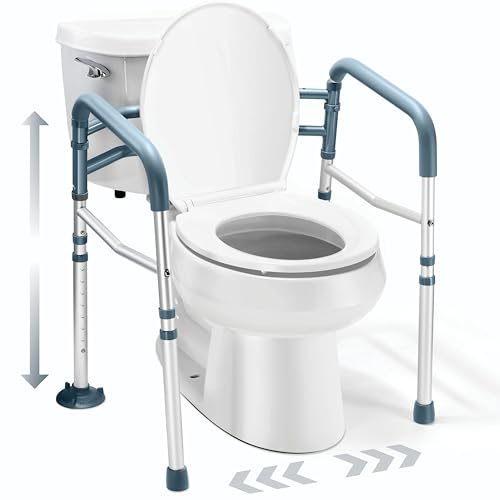
- Adjustable height and width
- Foldable rustproof aluminum frame
- Textured grips and replacement feet
Best For: Portable support for users needing flexible bathroom fit
Best Adjustable Fit

- Seven height and width adjustments
- Padded, non-slip armrests
- Foldable 350-pound aluminum frame
Best For: Users seeking adjustable, space-saving bathroom support
Best Stability Features
HOMLAND Adjustable Toilet Safety Rails

- Reinforced pivot with two C-clamps
- Adjustable 24–29.5-inch width
- Folds and includes pouch and tissue holder
Best For: Users wanting reinforced, portable toilet support
Best Fixed-Hinge Option
PELEGON Compact Toilet Safety Rails

- Compact L-shaped aluminum rail
- Supports up to 250 pounds
- Requires compatible fixed-hinge toilet
Best For: Users needing a compact mounted rail for a compatible toilet
Heavy-Duty Adjustable Pick
ZEAGUS 500-lb Toilet Safety Frame

- 500-lb carbon-steel capacity
- 17.7–20-inch adjustable width
- Folds flat and installs without drilling
Best For: Users wanting sturdy, toilet-mounted support
Flexible Freestanding Pick
PELEGON Adjustable Toilet Safety Rails

- 350-lb tested weight capacity
- Adjustable 24–30-inch height
- Lightweight, tool-free aluminum frame
Best For: Users needing repositionable, broadly adjustable support
Floor-Grip Value Pick
NEDA Adjustable Toilet Safety Rails

- 350-lb aluminum frame
- 20–25-inch width and 24–31-inch height
- Includes suction and spare rubber feet
Best For: Users needing adjustable support across floor types
Adjustable Aluminum Support – Lianjindun Adjustable Toilet Safety Rails
For shoppers comparing toilet safety frames for multiple sclerosis, the Lianjindun frame offers adjustable support for sitting down and standing up. Its aluminum construction, padded grips, foldable design, and broad height and width adjustments make it a flexible option for everyday bathroom use.
Best For: Users who want a foldable, highly adjustable frame with padded armrests and a stated 350-pound capacity.
Pros:
- Height adjusts from 24 to 31 inches, while width adjusts from 20 to 25 inches.
- Corrosion-resistant aluminum frame has a stated 350-pound capacity.
- Soft foam grips and replacement rubber feet provide additional grip and stability.
- Folds for storage or travel and assembles without tools.
Cons:
- The wide adjustment range may require careful positioning in smaller bathrooms.
- The supplied specifications list both a 350-pound capacity and a 300-pound minimum-weight entry, so shoppers should verify the applicable rating.
Overall, this is a practical choice when adjustability and portability matter. Confirm the frame’s dimensions and weight rating against the user’s needs before purchase.
Flip-Up High-Capacity Frame – Vive Toilet Safety Rail with Flip-Up Handles
When evaluating toilet safety frames for multiple sclerosis, the Vive rail stands out for its flip-up armrests and high stated capacity. It is designed to support sitting and standing while preserving access and floor space when the arms are folded away.
Best For: Users who need a compact, flip-up design and a stated 450-pound capacity for a compatible standard or elongated toilet.
Pros:
- Supports up to 450 pounds according to the supplied specifications.
- Flip-up armrests provide unobstructed access when not in use.
- Designed for standard and elongated flat-tank toilets with fixed, bolted seats.
- Assembles without extra tools and includes a lifetime guarantee.
Cons:
- Requires at least 2 inches of clearance between the seat bolt holes and tank.
- Not compatible with curved or irregular tanks, smart toilets, bidet toilets, or quick-release hinges.
This model is particularly useful in shared or smaller bathrooms, provided the toilet meets its installation requirements. Check compatibility carefully before ordering.
Simple Steel Stability – Carex Adjustable Toilet Safety Frame
For anyone seeking toilet safety frames for multiple sclerosis, the Carex Toilet Safety Frame provides straightforward grab-bar support without a complex feature set. Its adjustable width and cushioned, easy-clean grips are intended to help users sit or stand more securely at the toilet.
Best For: Users looking for an economical steel frame with adjustable width and a stated 300-pound capacity.
Pros:
- Width adjusts from 16 to 18 inches to fit most elongated and round toilets.
- Steel construction supports up to 300 pounds according to the supplied notes.
- Cushioned hand grips are comfortable and easy to clean.
- Designed for simple installation and can pair with a handicap toilet seat.
Cons:
- Its 16-to-18-inch width range is narrower than some adjustable frames.
- The supplied notes do not mention foldability or height adjustment.
Carex is a sensible option for buyers who prefer a basic, compact support frame. Measure the toilet and available space to confirm the adjustable width is suitable.
Portable Rustproof Support – Foldable Adjustable Toilet Safety Rails
These detachable rails are worth considering when shopping for toilet safety frames for multiple sclerosis and portability is important. The rustproof aluminum frame offers adjustable height and width, textured handles, extra-strong suction cups, and a foldable design for moving or storing the unit.
Best For: Users who want a portable, foldable frame with adjustable dimensions and a stated 300-pound capacity.
Pros:
- Height adjusts from 24 to 31 inches and width from 20 to 25 inches.
- Rustproof aluminum frame has a stated 300-pound capacity.
- Textured rubber handle pads and extra-strong suction cups support grip and stability.
- Folds for transport and can be assembled or dismantled in about two minutes.
Cons:
- The broad frame dimensions may take up more room than a narrower safety rail.
- As with any suction-foot design, users should ensure the feet are positioned securely before relying on the frame.
This frame combines adjustability with convenient portability, making it useful for home or travel applications. Verify the available bathroom space and fit before purchase.
Best Adjustable Fit – Loyoda Toilet Safety Frame
For shoppers comparing toilet safety frames for multiple sclerosis, the Loyoda frame offers adjustable support that can make sitting down and standing up more manageable. Its padded armrests, foldable aluminum construction, and broad fit range are practical features for everyday bathroom use.
Best For: Users who want a foldable, height- and width-adjustable frame with padded grips and a 350-pound capacity.
Pros:
- Seven height settings from 24 to 30 inches and width adjustment from 24.41 to 30.31 inches.
- Soft foam-padded handles provide a comfortable, non-slip grip.
- Reinforced aluminum frame supports up to 350 pounds and has oversized non-slip feet.
- Tool-free assembly and foldable storage suit smaller bathrooms or travel.
Cons:
- The frame weighs 6 pounds, which may be less convenient for some users to move.
- Its dimensions and fit should still be checked against the specific toilet before purchase.
The Loyoda is a versatile choice when adjustability and storage convenience matter. Confirm the available bathroom space and desired handle height before ordering.
Best Stability Features – HOMLAND Adjustable Toilet Safety Rails
Among toilet safety frames for multiple sclerosis, the HOMLAND model stands out for added stability features and flexible sizing. Its reinforced pivot, adjustable legs, padded handles, and foldable design are intended to support safer sit-to-stand transitions.
Best For: Users who prioritize extra frame reinforcement, adjustable sizing, portability, and included convenience accessories.
Pros:
- Two C-clamps at the backrest pivot add support to the aluminum frame.
- Width adjusts from 24 to 29.5 inches and height from 25 to 31 inches.
- Four non-slip flat foot pads, adjustable legs, and two extra suction cups are included.
- Folds for storage or travel and includes a pouch and tissue holder.
Cons:
- The frame weighs 6 pounds and may require space for its 18.3-inch depth.
- Although designed to fit most toilets, measurements should be verified before purchase.
HOMLAND is a strong option for shoppers who want more than basic rails, particularly the added pivot clamps and storage accessories. Its 350-pound capacity and one-year warranty add practical reassurance.
Best Fixed-Hinge Option – PELEGON Compact Toilet Safety Rails
For people evaluating toilet safety frames for multiple sclerosis, the PELEGON rail provides a compact, permanently mounted support option. Its L-shaped design is intended to improve stability, but compatibility is more limited than with freestanding frames, so measuring the toilet first is essential.
Best For: Users with a compatible fixed-hinge toilet who prefer a compact, bolted rail and need support up to 250 pounds.
Pros:
- Patent-pending L-shaped design is built around stability and support.
- Lab tested to hold up to 250 pounds.
- Compact 21-by-10-inch design takes less bathroom space than many freestanding frames.
- Assembly requires only a screwdriver, with instructions and assembly videos available.
Cons:
- Compatible only with fixed-hinge toilets having 5.5- to 6.4-inch bolt spacing.
- Not compatible with smart toilets, bidet toilets, quick-release seats, or irregular-shaped toilets.
- The 250-pound capacity is lower than the other listed options.
PELEGON makes sense when toilet compatibility is confirmed and a compact mounted rail is preferred. Measure bolt spacing and check the seat type before ordering.
Heavy-Duty Adjustable Pick – ZEAGUS 500-lb Toilet Safety Frame
For shoppers comparing toilet safety frames for multiple sclerosis, the ZEAGUS model combines a high weight capacity with two width settings and toilet-mounted support. Its carbon-steel frame, ergonomic handles, and fold-flat design may suit users who want stable assistance without floor legs in the way.
Best For: Users seeking a sturdy, toilet-mounted frame with adjustable width and a 500-pound capacity.
Pros:
- Supports up to 500 pounds with reinforced carbon-steel construction.
- Two width settings adjust from 17.7 to 20 inches.
- Folds 60 degrees for storage and has a leg-free design for easier cleaning.
- Installs without drilling or power tools on most standard toilets.
Cons:
- Not designed for smart toilets or non-standard toilet shapes.
- Requires removing and reinstalling the toilet seat during installation.
- Width adjustment is more limited than some freestanding models.
The ZEAGUS is a practical choice when a direct-toilet installation and high load rating are priorities. Confirm toilet compatibility and bolt spacing before ordering.
Flexible Freestanding Pick – PELEGON Adjustable Toilet Safety Rails
Among toilet safety frames for multiple sclerosis, the PELEGON stands out for broad height and handle-width adjustment. Its lightweight aluminum frame is designed for tool-free assembly, making it useful for households that need repositionable support or a temporary bathroom aid.
Best For: Adults who want a lightweight, freestanding frame with wide height and width adjustment.
Pros:
- Lab-tested to support up to 350 pounds.
- Height adjusts from 24 to 30 inches and handle width from 19 to 24.5 inches.
- Tool-free assembly and lightweight aluminum construction simplify setup and handling.
- Designed to accommodate almost any toilet type according to the supplied product notes.
Cons:
- Its freestanding design occupies bathroom floor space.
- At 350 pounds, its capacity is lower than the ZEAGUS model.
- Specific floor-foot details are not provided in the supplied notes.
The PELEGON offers a useful balance of adjustability and portability. Measure the available bathroom space and set the frame securely before relying on it for transfers.
Floor-Grip Value Pick – NEDA Adjustable Toilet Safety Rails
NEDA Toilet Safety Rails for Seniors, 350 lb, Adjustable Height & Width, Tool-Free Frame for Elderly
Check Price On AmazonFor people evaluating toilet safety frames for multiple sclerosis, the NEDA provides adjustable freestanding support with floor-foot options for different surfaces. Its hand-assembled design avoids drilling, while the 20- to 25-inch width and 24- to 31-inch height ranges allow a more personalized setup.
Best For: Users who need adjustable, floor-standing support for smooth or textured bathroom flooring.
Pros:
- Supports up to 350 pounds with a sturdy aluminum frame.
- Adjusts from 20 to 25 inches wide and 24 to 31 inches high.
- Includes suction-cup feet plus two spare rubber feet for different floor surfaces.
- Assembles by hand without drilling, wall damage, or a plumber.
Cons:
- Requires a 26-by-19.6-inch footprint, so space should be measured first.
- Users should avoid grout lines and push straight down rather than sideways on the handles.
- Designed for users who can bear weight on both legs; non-weight-bearing users are directed to wall-mounted support.
The NEDA is a sensible option for renters, apartments, and temporary recovery needs. Careful foot placement and correct setup are important for achieving the intended stability.
How We Picked the Best Toilet Safety Frames for Multiple Sclerosis
We focused on features that affect safe, repeatable toilet transfers: frame stability, weight capacity, height and width adjustment, compatibility with common toilets, handle ergonomics, and installation requirements. We also included models with different designs, including fixed side rails and flip-up handles, because bathroom layouts and mobility needs vary.
Weight ratings are useful for screening, but they should not be the only deciding factor. A frame must be correctly installed, firmly secured, and positioned so the user can grip it comfortably while lowering and rising.
Quick Comparison
- Best for higher stated capacity: ZEAGUS and Vive models offer ratings of up to 500 or 450 pounds.
- Best for broad adjustability: Lianjindun, HOMLAND, NEDA, and similar height-and-width adjustable frames can help accommodate different users and toilet setups.
- Best for easier access: Vive’s flip-up handles may be useful where caregivers need more room for transfers or cleaning.
- Best for simpler fit checking: Carex and other frames designed for common toilet configurations can be practical when you want a familiar, straightforward setup.
Key Buying Factors
Stability and Installation
Look for a frame that attaches securely to the toilet or floor, resists side-to-side movement, and includes clear hardware instructions. Tool-free installation can be convenient, but verify that the locking mechanism is genuinely secure and check it regularly for loosening.
Adjustable Height and Width
Height adjustment helps position the handles at a comfortable level, while width adjustment can improve clearance for the user’s hips and clothing. Measure the toilet area before ordering, including nearby walls, cabinets, and grab-bar locations.
Capacity and Handle Design
Choose a published weight capacity that comfortably exceeds the user’s body weight, while considering momentum during transfers. Padded, textured, or angled handles may be easier to grip for users with weakness, numbness, or reduced hand control. Flip-up arms can improve access but add moving parts that must lock reliably.
Toilet Compatibility and Maintenance
Confirm whether the frame fits a standard, elongated, raised, or specialty toilet. Consider clearance around the seat, ease of cleaning, corrosion-resistant materials, and whether the frame interferes with the lid or seat.
Who Should Buy Which Toilet Safety Frames for Multiple Sclerosis?
Choose a highly adjustable frame if multiple people will use the bathroom or precise positioning is important. A higher-capacity model may suit users who need extra support or caregivers who want a larger safety margin. Flip-up handles are worth considering when wheelchair, walker, or caregiver access is a priority.
For users with significant balance problems, sudden weakness, or difficulty bearing weight, a toilet safety frame should supplement—not replace—professional assessment. An occupational therapist or clinician can help determine whether a wall-mounted grab bar, raised toilet seat, commode, or other equipment is safer for the specific transfer.