A raised doorway threshold can make everyday movement difficult for wheelchair users, scooter riders, and anyone using a walker. The right ramp creates a smoother transition while helping reduce bumps, jolts, and trip hazards.
This roundup compares 10 threshold ramps for home use, from low-profile rubber strips to heavy-duty aluminum and modular designs. Use the buying guide below to match ramp height, width, traction, and capacity to your doorway.
Best 10 Threshold Ramps for Home Use Picks for 2026
Heavy-Duty Rubber Access

- Wide 35.5-inch rubber ramp with beveled edges
- Grooved non-slip surface for indoor or outdoor use
- One-piece design supports wheelchairs, scooters, and cars
Best For: Heavy-duty 3-inch doorway and curb transitions
Two-Piece Rubber Transition Set

- Two solid rubber ramps included
- Textured surface supports traction
- Designed for doorways, garages, sheds, and entries
Best For: Two narrow 3.1-inch home or garage thresholds
Adjustable Aluminum Access

- Assembles for 1- to 6-inch rise heights
- Adjusts to widths up to 31.5 inches
- Aluminum construction rated for 1,100 pounds
Best For: Changing indoor and outdoor step or threshold heights
Heavy-Duty Pick
LIEKUMM 3/4-Inch Threshold Ramp
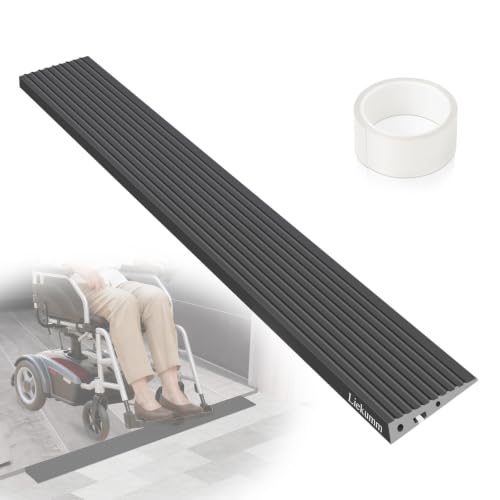
- 2,200-pound load capacity
- Anti-slip rubber surface
- Cuttable with cable channel
Best For: Low doorway thresholds indoors or outdoors
Style-Conscious Transition

- 40-inch transition strip
- Peel-and-stick installation
- Neutral interior-friendly finish
Best For: Low room-to-room floor transitions
Maximum Capacity
BESEA 3-Inch Rubber Threshold Ramp

- 3,500-pound load capacity
- Wide 18-inch rolling surface
- No assembly required
Best For: Taller rises and heavy mobility equipment
Best Low-Profile Pick

- 2,000-pound load capacity
- Grooved traction surface
- Cut-to-fit 35.5-inch width
Best For: Low door sills and everyday mobility equipment
Best Adjustable Aluminum Option

- 800-pound load capacity
- 1- to 4-inch height options
- Tool-free modular assembly
Best For: Higher thresholds and temporary or semi-permanent access
Best Heavy-Duty Rubber Pick

- 33,069-pound stated capacity
- Cuttable 35.4-inch width
- Anti-slip striped surface
Best For: Heavy-duty use across doorways, garages, and smooth tile
Heavy-Duty Rubber Access – 3-Inch VEVOR Threshold Ramp
For threshold ramps for home use that prioritize solid construction and a broad approach, this VEVOR model offers a 3-inch rise with beveled edges on all sides. Its one-piece rubber design works indoors or outdoors and needs no assembly.
Best For: Wheelchairs, scooters, carts, and other equipment crossing 3-inch thresholds at doorways, garages, gardens, or barns.
Pros:
- Wide 35.5-inch ramp with a stated 26.8-inch wheelchair clearance.
- Textured, grooved surface helps provide traction.
- Supports heavy traffic, including household cars, with a stated 2,200-pound capacity in the product description.
- Portable one-piece design requires no tools.
Cons:
- At 29 pounds, it is heavier than plastic or aluminum alternatives.
- Its fixed 3-inch height is less adaptable to different thresholds.
- May have a slight rubber smell when new.
This is a practical choice when stability and durability matter more than low weight or modular adjustment. Measure the threshold and available approach area before buying.
Modular Low-Slope Access – Ruedamann 2-Inch Threshold Ramps
These threshold ramps for home use stand out for their modular format. The two pieces can be combined or separated to create 1- or 2-inch rise configurations and 16- or 32-inch widths, making them useful for changing doorway requirements.
Best For: Homes needing a configurable, low-slope transition for wheelchairs, scooters, vehicles, or thresholds with concealed wiring.
Pros:
- Two-piece design supports multiple height and width configurations.
- Low 9-degree slope is intended to make access smoother.
- Honeycomb openings provide traction and drainage.
- Supports up to 3,000 pounds and offers adhesive or bolt mounting.
Cons:
- Mounting bolts are not included.
- Plastic construction may feel less substantial than solid rubber.
- Installation is more involved than a one-piece, tool-free ramp.
Ruedamann is a flexible option when a fixed-size ramp may not fit every entry. Confirm the desired configuration and plan for the appropriate mounting hardware.
Two-Piece Rubber Transition Set – iCAGY 3.1-Inch Ramps
If you need threshold ramps for home use at more than one entrance, this iCAGY set includes two rubber ramps with a 3.1-inch rise. The textured surface and low-angle profile are designed to help wheelchairs, scooters, carts, and walkers cross raised entries.
Best For: Homes, garages, sheds, and entryways that need two matching rubber ramps for 3.1-inch thresholds.
Pros:
- Two-piece package can cover separate locations.
- Textured rubber surface is intended to improve grip.
- Suitable for indoor and outdoor daily traffic.
- Works with wheelchairs, scooters, carts, and other equipment.
Cons:
- Each ramp is only 9.8 inches wide, so users should verify wheel clearance.
- The 3.1-inch rise is not adjustable.
- At 21 pounds total, the set is less lightweight than some modular options.
This set makes sense when you want durable rubber ramps for two locations and have relatively narrow thresholds. Check the individual ramp width carefully before purchase.
Adjustable Aluminum Access – Nuvium Modular Threshold Ramp
For threshold ramps for home use with more height flexibility, this Nuvium aluminum system can be assembled for rises from 1 to 6 inches. Its modular panels can form a width up to 31.5 inches or be separated for narrower wheels.
Best For: Indoor or outdoor access points with varying step heights, including doorways, curbs, driveways, and steps.
Pros:
- Six height options provide more adjustment than fixed-rise ramps.
- Panels can be combined or separated for different wheel widths.
- Aluminum alloy is corrosion-resistant and rated for up to 1,100 pounds.
- Anti-slip grooves, textured strips, and an underside mat support traction and stability.
Cons:
- Modular assembly is required before use.
- Its 1,100-pound capacity is lower than the supplied ratings of some rubber alternatives.
- Width and configuration should be checked carefully for larger mobility equipment.
Nuvium is the most adaptable pick here for households managing different threshold heights. Its aluminum construction also keeps the listed weight to 8.5 pounds, but careful setup and measurement remain important.
Heavy-Duty Pick – LIEKUMM 3/4-Inch Threshold Ramp
For threshold ramps for home use, the LIEKUMM 3/4-inch model combines a compact rise with a high 2,200-pound capacity. Its textured rubber surface, cable channel, and trimmable design make it practical for doorways used by wheelchairs, walkers, scooters, carts, and strollers.
Best For: Indoor or outdoor doorways needing a low-profile, customizable transition.
Pros:
- Supports up to 2,200 pounds.
- Textured anti-slip surface is designed for wet or dry conditions.
- Built-in cable groove and cuttable width improve installation flexibility.
- Can be combined with additional ramps for wider access.
Cons:
- The 3/4-inch height is intended for smaller thresholds rather than taller rises.
- Double-sided tape is included, but placement still requires careful alignment.
Choose this LIEKUMM ramp when you want a sturdy, adaptable doorway transition without giving up a relatively compact footprint.
Style-Conscious Transition – Gray Oak Ash Threshold Strip
Among threshold ramps for home use, this 40-inch PVC transition strip is designed for a subtle change between flooring surfaces. Its gray oak ash finish blends with interiors, while the peel-and-stick installation is intended to create smoother access for wheelchairs, walkers, and strollers.
Best For: Low transitions between rooms where appearance and simple installation matter.
Pros:
- Provides a smooth transition between floors.
- Cut, peel, and stick installation requires no special tools.
- Neutral gray oak ash color can complement home flooring.
- 40-inch length covers a broad doorway or transition area.
Cons:
- Its 1/2- to 3/5-inch height range is suited to low transitions.
- PVC construction and the supplied notes do not specify a load capacity.
This is a practical choice for homeowners who want an accessible floor transition with a less utilitarian appearance and a straightforward installation process.
Maximum Capacity – BESEA 3-Inch Rubber Threshold Ramp
For threshold ramps for home use involving taller rises or heavy equipment, the BESEA 3-inch rubber ramp offers a wide 18-inch surface and a 3,500-pound capacity. It is designed for doorways, garage entries, driveways, and curbs, with no assembly required.
Best For: Taller 3-inch thresholds and heavy wheelchairs, scooters, carts, or equipment.
Pros:
- Supports up to 3,500 pounds.
- Wide 18-inch surface provides a substantial rolling path.
- Textured rubber surface is designed to resist slipping in varied weather.
- Portable design requires no tools or assembly.
Cons:
- At about 35 pounds, it is less convenient to move than smaller ramps.
- The 3-inch height and 18-inch width require more space than a low-profile strip.
The BESEA is the stronger fit when stability, width, and load capacity take priority over portability or a discreet indoor profile.
Best Low-Profile Pick – 1-Inch Rubber Threshold Ramp
For many homes, threshold ramps for home use need to handle everyday mobility equipment without taking up much space. This 1-inch rubber ramp creates a gradual transition over low door sills and supports up to 2,000 pounds.
Best For: Low indoor or outdoor thresholds used by wheelchairs, power chairs, scooters, carts, bicycles, and robot vacuums.
Pros:
- Supports up to 2,000 pounds.
- Grooved surface helps improve traction in wet or dry conditions.
- Dense rubber construction suits indoor and outdoor use.
- Can be trimmed for narrower openings or placed side by side for wider entries.
Cons:
- The 1-inch rise is intended for low transitions rather than taller steps.
- May have a mild rubber odor or slight curve after unpacking.
- Adhesive strips work best on clean, dry, smooth surfaces.
This is a practical choice when you need a wide, cut-to-fit ramp for a modest threshold. Measure the vertical rise before ordering, and allow the rubber to flatten in a ventilated area if needed.
Best Adjustable Aluminum Option – 4-Inch Modular Threshold Ramp
If your doorway has a higher rise, this aluminum option offers a sturdier approach to threshold ramps for home use. Its modular design supports up to 800 pounds and is available in height configurations from 1 to 4 inches, with an additional 0.25-inch adjustment flap.
Best For: Taller home thresholds and users who want a rust-resistant ramp that can be assembled, secured, and stored as needed.
Pros:
- Supports up to 800 pounds.
- Aircraft-grade aluminum is designed for indoor or outdoor use.
- Modular sections assemble and disassemble without tools.
- Screw-in connectors and a stabilizing front edge help keep the ramp steady.
Cons:
- Its 800-pound capacity is lower than the rubber ramps in this roundup.
- Assembly and screw installation may be more involved than using a one-piece ramp.
- The listed 4-inch configuration is larger and heavier than a low-rise threshold ramp.
This ramp stands out when a low-profile rubber transition is not enough. Its adjustable flap can help bridge the final gap at the threshold, while the removable modular construction is useful for temporary or semi-permanent setups.
Best Heavy-Duty Rubber Pick – 1.6-Inch Cuttable Rubber Ramp
For demanding transitions, this solid rubber model is one of the more heavy-duty threshold ramps for home use. It has a 1.6-inch rise, a 35.4-inch width that can be cut to fit, and a stated load capacity of up to 33,069 pounds.
Best For: Doorways, garages, bathrooms, smooth tile, and other locations needing a durable, wide rubber transition for wheelchairs, carts, strollers, or robot vacuums.
Pros:
- Very high stated load capacity of up to 33,069 pounds.
- Natural rubber resists wear, high temperatures, and deformation.
- Anti-slip stripes help improve traction in wet conditions.
- Can be cut to match different threshold widths.
Cons:
- The 1.6-inch rise may not match thresholds that are lower or substantially higher.
- At 13.7 pounds, it is less lightweight than some smaller threshold solutions.
- A slight rubber smell may be present initially.
This model is a strong fit when durability and a generous load rating matter most. Measure the threshold carefully before cutting, and use the included double-sided tape on a smooth, clean surface to help limit shifting.
How We Picked the Best Threshold Ramps for Home Use
We focused on the factors that affect safe, practical doorway access: compatible rise height, usable ramp width, weight capacity, surface traction, material, installation requirements, and suitability for wheelchairs, mobility scooters, walkers, and other wheeled equipment. The selection includes low-profile transition strips for small floor changes, rubber ramps for straightforward home installation, and stronger modular or aluminum options for larger thresholds and heavier loads.
Because every doorway is different, measure the threshold and the available approach area before choosing a ramp. A product that works well for a front door may not suit a narrow bathroom entrance, sliding door, patio threshold, or exterior step.
Quick Comparison
- Lowest profiles: The 1/2-inch to 3/5-inch transition option and the 3/4-inch LIEKUMM ramp suit small height differences and floor transitions.
- Common household rises: The 1-inch, 1.6-inch, 2-inch, and 3-inch models cover many standard door thresholds.
- Higher access: The 4-inch aluminum VEVOR model is designed for taller rises, but requires careful checking of slope and approach space.
- Heavy-duty choices: Look to the modular Ruedamann, BESEA, and aluminum VEVOR options when capacity and structural strength are priorities.
- Wide coverage: Several VEVOR and cuttable rubber designs provide broad surfaces for wheelchairs and scooters.
Key Buying Factors for Threshold Ramps for Home Use
Rise Height and Slope
Measure the vertical height from the lower floor to the top of the threshold. Choose a ramp designed for that rise rather than relying on appearance. Taller rises generally need a longer ramp to provide a manageable slope, especially for manual wheelchair users.
Width and Doorway Clearance
Check the ramp’s actual usable width against the wheelchair, scooter, walker, or cart. Also confirm that the ramp will not interfere with the door swing, weather stripping, hinges, or nearby walls. A wide ramp can improve stability, but it may be unsuitable for a narrow entrance.
Material, Traction, and Weather Exposure
Rubber ramps are often stable, quiet, and easy to position, while aluminum models can offer lower weight and greater rigidity. For outdoor use, prioritize a textured or non-slip surface and verify that the product is rated for the expected weather conditions. Keep surfaces clear of water, ice, dirt, and leaves.
Capacity and Installation
Compare the stated load rating with the combined weight of the user, wheelchair or scooter, and any carried items. Check whether the ramp is freestanding, needs adhesive or fasteners, can be cut to fit, or uses modular sections. A secure fit is essential; movement at either end can create a hazard.
Who Should Buy Which Threshold Ramps for Home Use?
For small indoor transitions: Choose a low-profile strip or 3/4-inch ramp for carpet-to-tile changes and modest thresholds.
For standard doorways: A 1-inch to 2-inch rubber ramp is a practical starting point for many homes, provided its measurements match the threshold.
For taller thresholds: Consider a 3-inch or 4-inch model, but confirm that its length and slope are appropriate for the user and available space.
For scooters and heavier equipment: Favor a wide, high-capacity rubber, modular, or aluminum ramp with a secure surface and adequate clearance.