Finding the best lightweight adaptive utensils can make everyday meals more comfortable and manageable for people with tremors, arthritis, Parkinson’s, or reduced hand strength.
These sets vary in handle design, weight, angle, adjustability, and included pieces. The right choice depends on the user’s grip, wrist control, and preferred eating style.
Best 10 Lightweight Adaptive Utensils Picks for 2026
Best Travel-Ready Pick
BUNMO Lightweight Adaptive Utensils

- Soft foam handles are lightweight and non-slip
- Four-piece set includes a rocker knife
- Canvas wrap supports organized travel
Best For: Home meals, restaurants, and family gatherings
Best Customizable Grip
Bendable 4-Piece Adaptive Utensils

- Three utensils bend to a preferred position
- Wide handles support grip and control
- Suitable for right- or left-handed users
Best For: Users who need adjustable utensil angles
Best Everyday Value
Nourislif Lightweight Adaptive Utensils
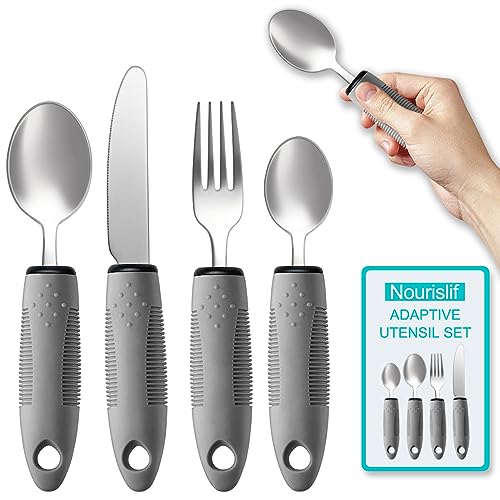
- Non-weighted design helps limit hand fatigue
- Built-up 1.25-inch contoured handles
- Complete four-piece dishwasher-safe set
Best For: Daily meals for adults needing steadier grip
Best Angle Adjustability

- Necks bend up to 180 degrees
- Lightweight, textured non-slip grips
- Reversible for either hand
Best For: Users needing customized wrist-friendly positioning
Best Weighted Stability

- 2.5-ounce weighting supports steadier handling
- Angled design reduces wrist rotation
- Built-up non-slip silicone grips
Best For: Right-handed users with tremors, Parkinson’s, arthritis, or limited dexterity
Best Low-Profile Option
Flat-Edge Non-Weighted Spoon Set

- Flat edge helps scoop from bowls and plates
- Non-weighted stainless steel design
- Includes tablespoon and teaspoon
Best For: Users seeking discreet, familiar spoons for easier scooping
Best Adjustable Versatility
270° Adjustable Adaptive Utensils

- Bendable design adjusts up to 270°
- Weighted, non-slip built-up handles
- Complete four-piece utensil set
Best For: Users needing customizable angles and added grip support
Best Simple Weighted Set
Nourislif 3-Piece Adaptive Utensils

- 2.7-ounce pieces offer a lighter weighted feel
- Easy-grip stainless steel set for tremor support
- Dishwasher safe with a one-year guarantee
Best For: Adults seeking a lightweight, basic adaptive utensil set
Best Angled Four-Piece Set
HJGL 45-Degree Adaptive Utensils

- 45-degree angle aims to reduce wrist movement
- Textured weighted handles support grip stability
- Includes fork, knife, tablespoon, and teaspoon
Best For: Right-handed users needing angled, complete adaptive cutlery
Best Soft-Grip Angled Set
KintKita 4-Piece Adaptive Utensils
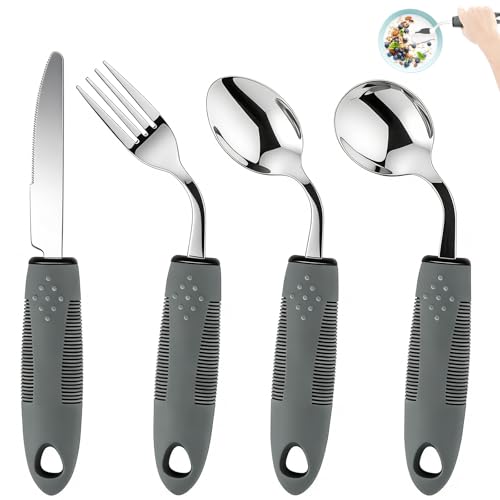
- Approximately 2.5–2.9 ounces per utensil
- 45-degree spoon and fork design supports wrist comfort
- Oversized textured silicone handles improve traction
Best For: Right-handed users prioritizing a softer, grippy handle
Best Travel-Ready Pick – BUNMO Lightweight Adaptive Utensils
For shoppers comparing lightweight adaptive utensils, this four-piece BUNMO set combines cushioned foam handles with a portable canvas wrap. It includes everyday flatware plus a curved rocker knife designed to cut without a sawing motion.
Best For: Seniors or adults with tremors, weak grips, or hand strain who want a complete set for home and travel.
Pros:
- Lightweight, non-slip foam handles help reduce hand strain.
- Includes a fork, tablespoon, teaspoon, and curved rocker knife.
- Reusable canvas wrap keeps the set organized for dining out.
- Rust-resistant stainless steel and dishwasher-safe construction.
Cons:
- The foam handles may require more care than an all-metal design.
- The set is offered in one listed gray adaptive style.
Choose this set when portability and a full meal-serving assortment matter as much as grip comfort. The included wrap is especially useful for caregivers or users who regularly carry adaptive flatware.
Best Customizable Grip – Bendable 4-Piece Adaptive Utensils
This four-piece option stands out among lightweight adaptive utensils for its adjustable positioning. The fork, teaspoon, and tablespoon can be bent to the user’s preferred angle, while the wide-grip handles are designed for added control.
Best For: Right- or left-handed users with arthritis, tremors, Parkinson’s, or reduced grip strength who need adjustable utensil positioning.
Pros:
- Fork, teaspoon, and tablespoon can be shaped to a preferred position.
- Wide handles and palm-aligned ribs support grip and control.
- Knife design accommodates both right- and left-handed users.
- Dishwasher safe up to 125 degrees.
Cons:
- Only three of the four utensils are identified as bendable.
- The listed set weight is 15.84 ounces, so it may not suit shoppers seeking the lightest option.
This set is a practical choice when fit and hand position are more important than a fixed utensil shape. Its adjustability may help users tailor the eating angle to their individual needs.
Best Everyday Value – Nourislif Lightweight Adaptive Utensils
Nourislif’s four-piece set is a straightforward choice for shoppers seeking lightweight adaptive utensils with built-up handles. The contoured, 1.25-inch-wide handles are intended to provide a steadier hold without added weighting.
Best For: Adults with hand tremors, arthritis, Parkinson’s, or weak grip strength who need familiar everyday silverware.
Pros:
- Non-weighted, lightweight design may be easier to lift and maneuver.
- Built-up contoured handles provide enhanced stability and control.
- Includes a tablespoon, teaspoon, knife, and fork.
- Rustproof stainless steel and dishwasher-safe construction.
Cons:
- The set does not include a carrying case or travel wrap.
- Its fixed handles do not offer bendable angle adjustment.
This is a sensible daily-use set for buyers who want simple adaptive flatware rather than specialized positioning features. The one-year guarantee adds a measure of purchase reassurance.
Best Angle Adjustability – Bendable Fork and Spoon Set
For buyers who need highly personalized positioning, this two-piece set offers lightweight adaptive utensils with necks that bend up to 180 degrees. A textured grip and reversible design support use with either hand.
Best For: Seniors or disabled adults with limited wrist mobility, arthritis, weak hands, or changing hand positions.
Pros:
- Fork and spoon can bend to a preferred angle up to 180 degrees.
- Lightweight construction is designed to reduce hand fatigue.
- Textured, larger grip helps resist slipping with wet or trembling hands.
- Reversible for right- and left-handed use; dishwasher safe.
Cons:
- Includes only a fork and spoon, not a knife or complete flatware set.
- The set may be less suitable for shoppers who need multiple utensils at once.
This pair is best viewed as a targeted mobility aid rather than an all-purpose silverware replacement. The substantial angle range makes it appealing when wrist twisting is a primary concern, and the velvet pouch supports gifting or storage.
Best Weighted Stability – 42° Angled Weighted Utensils
For shoppers comparing lightweight adaptive utensils with added stability, this four-piece set combines a moderate 2.5-ounce weight with a 42° angled design. Its built-up silicone handles are intended to reduce wrist rotation and make gripping easier during meals.
Best For: Adults with hand tremors, Parkinson’s, arthritis, or limited dexterity who want angled, weighted flatware for daily eating.
Pros:
- 42° angled design may reduce wrist rotation and fatigue.
- Moderate 2.5-ounce weighting supports steadier control without excessive bulk.
- Large, textured, non-slip silicone handles provide a more secure grip.
- Includes a fork, knife, and soup spoon with dishwasher-safe stainless steel eating surfaces.
Cons:
- The weighted design may not suit users who prefer completely non-weighted utensils.
- The set is specified for right-handed use.
- Only three utensil types are listed despite the four-piece-set description.
This is a practical choice when tremor support and wrist positioning matter more than having the lightest possible flatware. The angled, built-up design may also help users who find standard handles difficult to control.
Best Low-Profile Option – Flat-Edge Non-Weighted Spoon Set
These lightweight adaptive utensils take a low-profile approach: two familiar stainless steel spoons with flat edges rather than angled or built-up handles. They are a suitable option for shoppers who want adaptive functionality while keeping the look and feel close to everyday silverware.
Best For: Older adults and users with Parkinson’s, arthritis, weak grip, or limited dexterity who primarily need easier scooping from bowls and plates.
Pros:
- Flat-edge spoon heads are shaped to follow the curve of a standard bowl or plate.
- Non-weighted construction avoids the bulk of heavy weighted handles.
- Simple shape works in either hand without a special grip.
- Includes an 8.3-inch tablespoon and a 5.9-inch teaspoon.
Cons:
- This is a spoon-only set, with no fork or knife.
- It provides less specialized tremor support than weighted or angled utensils.
- The smaller piece is a teaspoon, not a second full-size spoon.
If discreet, everyday-looking flatware is a priority, this set is the simplest choice of the three. Its main benefit is improved scooping rather than handle stabilization or weight-assisted tremor control.
Best Adjustable Versatility – 270° Adjustable Adaptive Utensils
For users whose hand position varies from meal to meal, this four-piece set offers 270° adjustable metal utensils with weighted handles. The built-up, non-slip grips and enlarged spoon sizes add control while allowing the pieces to be bent toward a more comfortable angle.
Best For: Users with tremors, arthritis, limited grip strength, or reduced hand control who need adjustable positioning and a complete utensil set.
Pros:
- 270° bendable angle allows customized positioning.
- Weighted handles may improve stability for users with hand tremors or weak grip.
- Built-up, non-slip handles are designed for secure everyday handling.
- Complete set includes a fork, knife, tablespoon, and enlarged teaspoon.
Cons:
- Weighted handles may feel less lightweight than standard flatware.
- Adjusting the metal angle requires bending the utensil to the desired position.
- The enlarged spoon design may not suit users who prefer smaller spoon bowls.
This set stands out for adjustability and completeness. It is a strong fit when a fixed-angle utensil may not match the user’s grip, although shoppers prioritizing the lightest feel may prefer the non-weighted spoon set.
Best Simple Weighted Set – Nourislif 3-Piece Adaptive Utensils
If you want lightweight adaptive utensils with a steady, easy-grip design, the Nourislif set is a straightforward option for everyday meals. Each piece weighs 2.7 ounces and is designed for adults managing hand tremors, arthritis, Parkinson’s, weak grip, or other dexterity challenges.
Best For: Adults who want a compact, dishwasher-safe set with a tablespoon, knife, and fork.
Pros:
- Light 2.7-ounce-per-piece design balances stability with manageable weight.
- Easy-grip handles are intended to support users with tremors or weak hand strength.
- Rustproof stainless steel construction and dishwasher-safe care simplify daily use.
- Includes a one-year Nourislif guarantee.
Cons:
- The set includes three pieces and does not include a teaspoon.
- The supplied details do not specify an angled or left-handed design.
This is a practical pick when you prioritize a lighter weighted feel, basic place-setting coverage, and easy cleanup over specialized wrist positioning.
Best Angled Four-Piece Set – HJGL 45-Degree Adaptive Utensils
For shoppers comparing lightweight adaptive utensils with more specialized positioning, this HJGL right-handed set combines weighted, textured handles with a 45-degree angled design. It is intended to reduce wrist movement while supporting users with tremors, arthritis, Parkinson’s, neuropathy, or reduced grip strength.
Best For: Right-handed users who want a complete four-piece set with a fork, knife, tablespoon, and teaspoon.
Pros:
- 45-degree design is intended to guide food to the mouth with less wrist movement.
- Weighted, textured handles provide tactile feedback and help resist slipping.
- Includes four useful pieces, including both tablespoon and teaspoon.
- Food-grade stainless steel construction is dishwasher safe.
Cons:
- This listed version is specifically right-handed.
- At 11.2 ounces for the set, it may feel less lightweight than simpler adaptive options.
The HJGL set stands out for its angled configuration and fuller place setting, making it worth considering when wrist comfort and utensil variety matter more than minimizing total weight.
Best Soft-Grip Angled Set – KintKita 4-Piece Adaptive Utensils
The KintKita set is a strong option for shoppers seeking lightweight adaptive utensils with a softer, high-traction grip. Its 45-degree angled spoon and fork, approximately 2.5 to 2.9 ounces per piece, and oversized silicone handles are designed to support steadier eating for right-handed users.
Best For: Right-handed seniors and adults who want angled utensils with textured silicone handles for tremor, arthritis, or weak-grip support.
Pros:
- Each utensil weighs approximately 2.5 to 2.9 ounces for a relatively manageable feel.
- 45-degree angles on the spoon and fork are intended to ease wrist strain.
- Oversized, textured silicone handles improve traction and control.
- Includes four pieces and is dishwasher safe.
Cons:
- The product is specified for right-handed use.
- The supplied details do not identify the exact pieces included in the four-piece set.
Choose KintKita if grip comfort is a priority and you want angled utensils without an excessively heavy feel. The silicone handles add a useful distinction for users who find smooth or narrow handles difficult to control.
How We Picked the Best Lightweight Adaptive Utensils
We focused on practical features that affect daily use: overall weight, handle thickness, grip comfort, utensil balance, adjustable or angled designs, and the mix of pieces included. We also considered whether a set is intended for tremors, weak grip, limited wrist movement, or general assistance.
Because comfort and control are highly personal, this roundup includes several design types rather than treating one style as universally best. Lightweight foam-handled sets may suit users who tire easily, while mildly weighted or angled utensils can provide more stability and help keep the utensil aligned with the mouth.
Quick Comparison
| Design | Best For | Main Advantage | Potential Trade-Off |
|---|---|---|---|
| Lightweight built-up handles | Weak grip or hand fatigue | Easy to hold and lift | May offer less tremor control |
| Angled utensils | Limited wrist movement | Reduces the need to rotate the wrist | Requires adjustment to the eating angle |
| Weighted utensils | Mild to moderate tremors | Added mass may steady movement | Can feel tiring for weak hands |
| Bendable or adjustable utensils | Individual positioning needs | Can be customized to the user | May require occasional repositioning |
Key Buying Factors for Lightweight Adaptive Utensils
Weight and Balance
Do not assume heavier is better. Added weight may reduce small shaking for some users, but it can increase fatigue for people with limited strength. Look for a balanced utensil that feels stable without pulling the wrist downward.
Handle Size and Grip
Built-up handles are usually easier to grasp than slim conventional silverware. Foam, rubber, or textured surfaces can improve comfort, but the handle should not be so large that the user cannot close their fingers around it securely.
Angle and Adjustability
Angled forks and spoons can help people who have difficulty bending or rotating the wrist. Bendable and multi-position models offer more customization, although they may need to be adjusted for each user and each utensil.
Included Pieces and Care
Check whether the set includes a knife, fork, teaspoon, and tablespoon, or only selected pieces. Confirm cleaning instructions, especially if the handles have foam or other materials that may not be dishwasher-safe.
Who Should Buy Which Lightweight Adaptive Utensils?
Choose a lightweight built-up set for weak grips, hand fatigue, or users who prioritize easy lifting. Consider angled utensils for Parkinson’s, arthritis, or restricted wrist motion. Weighted designs may be more suitable when tremors are the main concern and the user can comfortably manage extra mass. Adjustable or bendable sets are worth considering when a standard angle does not work well.
If symptoms are significant or changing, an occupational therapist can help assess grip strength, utensil weight, and wrist positioning. A trial period is often useful because the most comfortable adaptive utensil depends on the individual’s movement pattern and daily needs.