Choosing the right brace after ACL surgery can make rehab feel more controlled and less frustrating. The best options balance support, adjustable motion, and day-to-day comfort.
In this roundup, we focus on braces that are designed to help protect the knee during recovery while still allowing the movement your rehab plan requires.
Best 10 ACL Post Op Brace Picks for 2026
Adjustable post-op support
Breg T Scope Premier Post Op Knee Brace
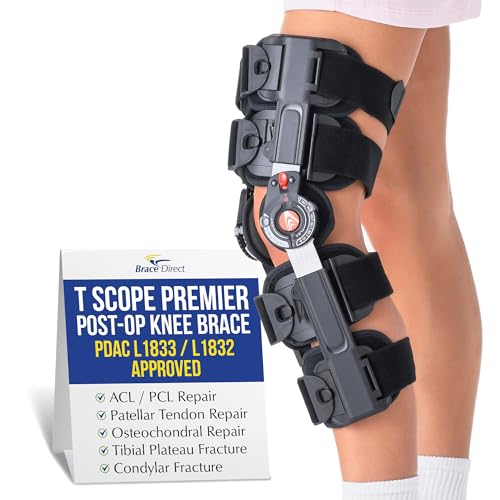
- Telescoping frame adjusts from 17" to 27"
- ROM settings support ACL, MCL, PCL, and LCL recovery
- Fits thighs up to 30.5" circumference
Best For: Post-surgical recovery with customizable stability
Comfort-focused rehab brace
Breg T Scope Premier Post-Op Knee Brace

- Adjustable flexion and extension stops
- Lightweight padded build for comfort
- Fits right or left leg procedures
Best For: Knee surgery rehab with adjustable motion control
Right-leg ligament support
Apex ACL Knee Brace for Ligament Injury

- Double uprights reinforce key knee ligaments
- ROM hinge adjusts from 0°-25° extension and 0°-90° flexion
- Non-slip padding helps the brace stay in place
Best For: Right-leg ACL and ligament recovery
Precision ROM Support
KD ROM Hinged Knee Brace for ACL Recovery

- 0° to 120° ROM adjustment
- Soft breathable padding and cushioned lining
- Quick-clip buckles with aluminum hinges
Best For: Post-op ligament recovery with adjustable motion control
Comfortable Rehab Choice

- 0° to 120° adjustable ROM
- Soft inner lining with adjustable straps
- Hinge support for ACL/MCL/PCL/LCL recovery
Best For: Post-op rehab with comfort-focused support and motion control
Adjustable Dial Recovery Pick
Hinged ROM Knee Brace with Side Stabilizers

- 0° to 120° locking dial for controlled rehab
- Lightweight aluminum alloy frame with side stabilizers
- Breathable, non-slip fit for left or right leg
Best For: Adults recovering from ACL and related knee injuries who want adjustable motion control
Easy-On Rehab Pick
Hinged ROM Knee Brace with Quick-Release Buckles

- 10-degree ROM control for flexion and extension
- Quick-release buckles simplify everyday use
- Expandable fit with soft inner lining
Best For: Post-op adults who want adjustable support and easier on/off wear
Shoulder-Strap Stability Pick

- ROM dial supports controlled post-op motion
- Ambidextrous universal fit for either leg
- Removable shoulder strap helps reduce slipping
Best For: Recovery users who want extra support and a universal fit
Adjustable post-op support – Breg T Scope Premier Post Op Knee Brace
If you need an ACL post op brace that prioritizes adjustable support, the Breg T Scope Premier is built for post-surgical recovery after ACL, MCL, PCL, or LCL procedures. Its telescoping frame and ROM settings make it easier to match the brace to your recovery stage while keeping the knee stabilized.
Best For: Post-op patients who want a medical-grade brace with adjustable length and range-of-motion control.
Pros:
- Adjustable ROM settings for targeted post-surgery support
- Telescoping frame extends from 17″ to 27″ for a personalized fit
- Fits thigh circumferences up to 30.5″
- Quick clip buckles make application simpler during tender recovery stages
Cons:
- Standard sizing may not suit larger thighs beyond the stated limit
- Designed for recovery support rather than casual everyday comfort
Overall, this is a practical choice if you want a stable ACL post op brace that can be adjusted as swelling and recovery needs change. The free video fitting support may also help users get the fit dialed in more accurately.
Comfort-focused rehab brace – Breg T Scope Premier Post-Op Knee Brace
This Breg T Scope Premier is a straightforward ACL post op brace option for patients who need adjustable range-of-motion control and a comfortable, lightweight build. The telescoping sleeves and bilateral compatibility make it a practical pick for rehab after knee surgery on either leg.
Best For: Rehabilitation after knee surgery when adjustable ROM control and a comfortable fit matter most.
Pros:
- Precise flexion and extension stops for recovery control
- Telescoping calf and thigh sleeves fit most body types
- Compatible with right or left leg procedures
- Padded, lightweight design supports better wear compliance
Cons:
- Thigh fit is limited to the stated size range unless using the larger versions
- Less specialized if you need extra anti-slip features
For buyers who want a familiar post-op brace with adjustable motion settings and a comfortable feel, this model covers the essentials without unnecessary complexity. It’s a solid recovery-focused choice for guided rehab.
Motion control with anti-slip support – Orthomen Hinged ROM Knee Brace
For shoppers comparing an ACL post op brace that helps control motion and stay put, the Orthomen Hinged ROM Knee Brace adds both ROM dials and anti-slip support. The shoulder strap and silicone lining are aimed at solving brace migration during walking or physical therapy.
Best For: Users who want precise motion limits and extra help preventing the brace from sliding down.
Pros:
- 0°-120° extension and flexion settings for controlled rehab
- Detachable padded shoulder strap helps keep the brace positioned
- Anti-slip silicone lining improves stability during movement
- Tool-free telescoping frame and quick-release buckles simplify use
Cons:
- More complex setup than a basic immobilizer
- Shoulder strap may be unnecessary for users who do not experience brace slippage
This model stands out if your main issue is keeping the brace secure while still using a precise ROM setting for recovery. It’s built for practical day-to-day rehab where comfort, movement control, and stability all matter.
Right-leg ligament support – Apex ACL Knee Brace for Ligament Injury
If you need an ACL post op brace for a right-leg fit, the Apex ACL Knee Brace is designed for stability after ligament injury and post-op recovery. Its double upright construction and adjustable ROM hinge make it a strong option when controlled support is a priority.
Best For: Right-leg recovery and sports use when you want strong ligament support and adjustable motion limits.
Pros:
- Double upright design reinforces ACL, MCL, PCL, and LCL support
- Extension adjusts from 0°-25° and flexion from 0°-90°
- Non-slip padding and one-step closure improve security
- Measured fit is sized for a 21-23.5 inch thigh circumference
Cons:
- Right leg only, so it won’t work for left-leg recovery
- Large size may not fit users outside the stated measurement range
Compared with more universal rehab braces, this one is more targeted for right-leg users who want ligament reinforcement and controlled range of motion. It makes sense for active recovery when fit and stability matter.
Precision ROM Support – KD ROM Hinged Knee Brace for ACL Recovery
If you’re comparing an ACL post op brace for controlled recovery, this hinged model is built around adjustable motion and day-to-day stability. It offers ROM settings from 0° to 120°, plus soft breathable padding and quick-clip buckles to make extended wear more practical after surgery or ligament injury.
Best For: Post-op ACL, MCL, PCL, and LCL recovery when you want adjustable motion control and a more comfortable fit.
Pros:
- Adjustable flexion and extension from 0° to 120° for staged rehabilitation
- Soft, breathable lining with cushioned padding for less pressure and irritation
- Durable aluminum hinges for added knee stability during daily activity
- Quick-clip buckles and adjustable straps for easier on/off and fit
Cons:
- One-size design may still require careful strap adjustment for a secure fit
- Shoulder strap is mentioned as helpful for reducing slip, but not included in the core description
This brace is a solid choice if your recovery plan calls for controlled knee motion rather than full immobilization. The combination of ROM adjustment, padding, and hinge support makes it practical for both rehab and everyday movement.
Locked Stability Pick – Upgraded Hinged ROM Knee Brace
For shoppers who want an ACL post op brace with stronger movement limits, this hinged ROM brace focuses on stability and controlled recovery. Its dual lock knobs let you set a 10° to 105° range of motion, while the removable side stabilizers and four straps are designed to improve support and fit.
Best For: Post-surgery recovery and knee injuries when limiting movement and adding side support are priorities.
Pros:
- Dual adjustable lock knobs for controlled motion limits
- Range of motion adjustment from 10° to 105° to help prevent hyperextension and flexion
- Removable side stabilizers for added support
- Lightweight neoprene, nylon, and polyester build for comfortable wear
Cons:
- Medium size means buyers need to match the sizing chart carefully
- Less motion range than braces that allow full 0° to 120° adjustment
This is a practical option if you want a more immobilizing feel without giving up all mobility. The tradeoff is a narrower ROM window, but that can be useful during earlier recovery stages or when extra movement control matters.
Comfortable Rehab Choice – ROM Hinged Post-Op Knee Brace
If you’re looking for an ACL post op brace with a straightforward rehab focus, this hinged ROM design emphasizes stability, comfort, and adjustable motion. It supports ACL, MCL, PCL, and LCL recovery with a 0° to 120° range of motion, plus a soft inner lining and adjustable straps for longer wear.
Best For: Rehab support after ligament procedures when you want adjustable range control and a softer feel.
Pros:
- Adjustable flexion and extension from 0° to 120°
- Robust hinge mechanism for added stability during movement
- Soft inner lining and adjustable straps for comfort
- Suitable for ACL, MCL, PCL, and LCL post-surgical support
Cons:
- Small size may not suit all users
- Shoulder strap is mentioned as an option for reducing slip, but not part of the core brace description
This brace stands out for balancing support and wearability. If your recovery plan includes controlled knee motion and you want a softer interior against the skin, it is a reasonable fit for post-op use.
Adjustable Dial Recovery Pick – Hinged ROM Knee Brace with Side Stabilizers
If you need an ACL post op brace that lets you progress step by step, this hinged ROM knee brace is built around controlled motion. The locking dial adjusts from 0° to 120°, so it can support everything from early immobilization to more gradual flexion and extension as your recovery plan changes.
Best For: Adult users who want a universal-fit post-op knee brace with adjustable ROM for ACL, PCL, MCL, meniscus, and general instability recovery.
Pros:
- Locking dial provides adjustable range-of-motion control from 0° to 120°.
- Aluminum alloy frame and strong hinges aim to provide stable support without excessive bulk.
- Breathable materials, quick-release buckles, and multiple straps help improve comfort and reduce sliding.
- Universal design fits either left or right leg for added convenience.
Cons:
- One-size universal design may not be ideal for every leg shape or size.
- ROM adjustment adds versatility, but it may be more brace than needed for simpler support use cases.
Overall, this is a practical ACL post op brace choice if your priority is controlled rehab progression and secure day-to-day wear. It stands out for its adjustable ROM dial and stable construction, making it a strong option for structured recovery.
Easy-On Rehab Pick – Hinged ROM Knee Brace with Quick-Release Buckles
This ACL post op brace is designed for recovery situations where controlled movement and straightforward daily use both matter. Its adjustable dial with two plastic stops lets you fine-tune motion in 10-degree increments, while the quick-release buckle system makes it easier to put on and take off after the initial setup.
Best For: Adults needing a post-op knee immobilizer with adjustable ROM, strong support, and easy on/off convenience.
Pros:
- Adjustable dial supports 0-120° flexion and 0-90° extension in 10-degree increments.
- Quick-release buckles make the brace easier to remove and reapply after setup.
- Expandable sizing fits a wide adult range, with adjustable length and circumference limits.
- Soft inner lining and adjustable straps are designed to improve long-wear comfort.
Cons:
- With so many fit adjustments, initial setup may take some time.
- The brace is built for post-surgical support, so it may feel more substantial than a basic sleeve.
If you want a dependable ACL post op brace with easy access and precise motion limits, this model is a solid contender. It balances recovery-focused support with practical features that make it easier to live with during longer rehab periods.
Shoulder-Strap Stability Pick – Universal Hinged Knee Brace
For buyers comparing an ACL post op brace, this universal hinged knee brace stands out for its broad adjustment range and removable shoulder strap. The locking dial supports controlled motion during recovery, while the adjustable length and ambidextrous design make it easier to fit either leg.
Best For: Adults recovering from ACL, MCL, PCL, meniscus, or fracture-related knee issues who want a universal brace with extra support from a shoulder strap.
Pros:
- Adjustable ROM dial helps control flexion and extension during rehab.
- Universal, ambidextrous design works for left or right leg.
- Removable shoulder strap adds support and can help reduce slipping.
- Breathable inner lining and non-slip fabric are designed for more comfortable wear.
Cons:
- At 3.2 pounds, it may feel heavier than simpler knee supports.
- Shoulder strap support may be more than some users want for routine wear.
This is a strong choice if you want a more secured-feeling brace for structured rehabilitation. Its combination of motion control, universal fit, and extra strap support makes it especially practical for recovery use.
How We Picked the Best ACL Post Op Brace Options
We focused on braces built for postoperative knee support, with features that matter most during rehab: hinged construction, adjustable range-of-motion control, secure fit, and practical comfort for extended wear. We also looked for models suitable for common recovery needs such as ACL, MCL, and PCL support, since many buyers need one brace that can handle multiple scenarios.
Quick Comparison
When comparing an ACL Post Op Brace, think in terms of support level, adjustment style, and comfort. Some braces are better for early recovery and strict immobilization, while others are more appropriate once your clinician wants controlled bending and walking. A simpler brace can be easier to manage, but a more adjustable design may be better if your rehab plan changes over time.
Key Buying Factors for ACL Post Op Brace
Range of Motion Control
Look for clear ROM settings if you need to limit flexion and extension. This is one of the most important features because recovery often progresses in stages. A brace with easy-to-read adjustments can help you stay aligned with your protocol.
Fit and Sizing
Proper sizing affects both comfort and effectiveness. Measure carefully and check whether the brace accommodates your thigh and calf dimensions. A poor fit can slip, create pressure points, or reduce stability.
Stability and Hinge Design
Hinged supports with side stabilizers or dual uprights typically provide more structured support than basic sleeves. If you need extra protection while walking, standing, or doing rehab exercises, this is a major feature to prioritize.
Comfort for Daily Wear
Soft padding, breathable materials, and easy straps matter more than many buyers expect. An ACL Post Op Brace may be worn for long periods, so comfort can influence whether you actually keep it on as directed.
Who Should Buy Which ACL Post Op Brace?
If you are in the early stages of recovery and need more restriction, choose a brace with strong immobilization and straightforward ROM control. If you are transitioning into walking and exercise-based rehab, a more adjustable hinged model may be the better fit. Buyers recovering from multiple ligament issues or meniscus procedures should lean toward braces with reinforced stabilization and reliable locking mechanisms.
For the safest choice, always align the brace with your surgeon’s or physical therapist’s instructions. The best brace is the one that matches your recovery stage, your size, and your rehab goals.