Moving someone between a bed, chair, bathroom, or wheelchair can be physically demanding for both the caregiver and the person being assisted. The right transfer chair can make routine indoor transfers more controlled, comfortable, and manageable.
This roundup compares 10 patient transfer chairs for indoor use, including manual, hydraulic, electric, commode, and foldable designs. Use the guide below to match features and lifting capacity to your home, care routine, and mobility needs.
Best 10 Patient Transfer Chairs for Indoor Use Picks for 2026
Best Heavy-Duty Support

- 400-pound recommended capacity
- Dual-locking caster system
- Adjustable knee pad and padded supports
Best For: Caregiver-assisted transfers for users who can sit upright and support their core
Best All-in-One Transfer Option
4-in-1 Portable Patient Lift Chair

- Functions as lift, wheelchair, bath, and commode chair
- 180-degree split seat
- 16- to 24-inch adjustable seat height
Best For: Home caregivers who need transfer and bathroom functionality in one chair
Best Electric Height Adjustment
Foldable 400-lb Transfer Chair

- One-button electric height adjustment
- Flat and open-seat cushions included
- Foldable frame with swivel wheels
Best For: Caregivers needing height-matched transfers and easier storage
Best Manual Indoor Design
Adjustable Mechanical Transfer Chair

- No batteries or motor required
- 16- to 24-inch adjustable seat height
- Two removable cushion styles
Best For: Power-free indoor transfers between common household seating and bathroom surfaces
Best Portable Electric Lift
VOCIC AY06 Electric Transfer Lift

- One-button electric height adjustment
- Foldable design fits car trunks
- 330-pound maximum recommended weight
Best For: Caregivers needing powered transfers between beds, seating, toilets, and cars
Best Heavy-Duty Commode Chair
Portable Hydraulic Transfer Chair

- Hydraulic height adjustment
- Detachable commode bucket
- 440-pound stated capacity
Best For: Home caregivers needing transfer and toileting functions in one chair
Best Multifunctional Split-Seat Chair
Drexo 5-in-1 Lift Transfer Chair
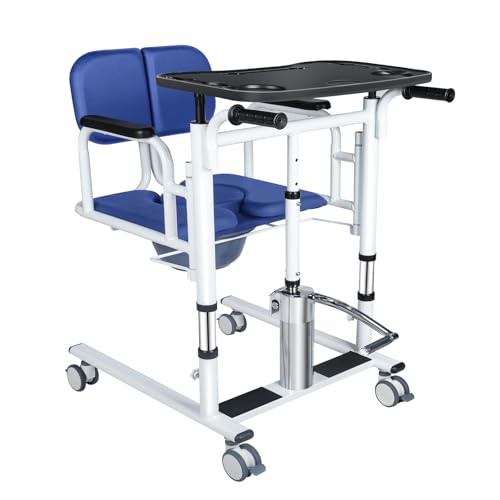
- Five functions with integrated commode
- 180-degree split seat
- Fold-flat frame with locking casters
Best For: Caregivers needing adaptable bedside, shower, toilet, and transfer support
Best Adjustable Manual Lift
Portable Sit-to-Sit Transfer Chair

- Adjustable height and base width
- Manual crank with locking casters
- Foldable design with washable cushions
Best For: Upright users needing caregiver-assisted indoor transfers
Best High-Capacity Hydraulic Option
180° Split-Seat Transfer Chair

- 330.7-pound maximum capacity
- 180° split-seat reclining design
- Detachable potty and tabletop included
Best For: Caregiver-assisted transfers in homes or care facilities
Best 4-in-1 Design

- Functions as bath, commode, wheelchair, and seat
- Adjustable base and seat height
- Lockable casters and two cushions
Best For: Caregivers needing one chair for several indoor tasks
Best Heavy-Duty Support – VOCIC Sit-to-Stand Lift Chair
Among patient transfer chairs for indoor use, the VOCIC Sit-to-Stand Lift is suited to users who can remain seated and support their upper body. Its reinforced frame, padded contact points, and locking casters are designed for caregiver-assisted transfers around the home.
Best For: Users with sufficient core and sitting ability who need a sturdy sit-to-stand aid for indoor transfers.
Pros:
- Supports up to 400 pounds with a reinforced aluminum frame.
- Dual-locking front and rear casters help keep the unit stationary during positioning.
- Padded handgrips, shin pads, and split-seat cushions improve contact comfort.
- Adjustable knee support and a low 6 cm base accommodate varied positioning needs.
Cons:
- Does not include or support a safety-belt restraint.
- Not recommended for completely immobile, paralyzed, or unable-to-sit users.
- At 58 pounds, it may be less convenient to carry between rooms.
This is a strong option when weight capacity and stability matter more than compact portability. Confirm that the user can support their upper body and that the chair’s 31-inch depth fits the intended indoor spaces.
Best All-in-One Transfer Option – 4-in-1 Portable Patient Lift Chair
This 4-in-1 model combines a patient lift, wheelchair, bath chair, and commode chair, making it a versatile choice among patient transfer chairs for indoor use. Its split seat, adjustable height, and locking casters support transfers between beds, furniture, and bathroom fixtures.
Best For: Caregivers assisting seniors or adults with mild to moderate disabilities who need one chair for transfers, bathing, and toileting.
Pros:
- 180-degree split seat can accommodate wheelchair users and transfers from different angles.
- Adjustable seat height from 16 to 24 inches helps align with beds, sofas, and toilets.
- Open commode design supports toileting and hygiene routines.
- Locking casters and a reinforced steel frame support controlled movement.
Cons:
- Supports up to 220 pounds, which is lower than some heavy-duty alternatives.
- Not intended for very weak or bedridden users.
- Weighs 58.6 pounds, so it is not especially lightweight.
The combination of transfer, commode, bath, and wheelchair functions makes this a practical space-saving solution. Check the 220-pound capacity and ensure the intended user falls within the stated mild-to-moderate assistance range.
Best Electric Height Adjustment – Foldable 400-lb Transfer Chair
Toptople 400 lb Electric Patient Lift Transfer Chair for Elderly & Disabled,Foldable (Black)
Check Price On AmazonFor caregivers who want powered positioning, this electric transfer chair offers one-button height adjustment from 34 to 46 inches. It is a useful choice among patient transfer chairs for indoor use when aligning a seated user with beds, sofas, wheelchairs, toilets, or car seats.
Best For: Caregiver-assisted transfers that benefit from electric height matching and a foldable frame for storage or transport.
Pros:
- Electric height adjustment helps reduce manual lifting during transfers.
- Supports up to 400 pounds according to the product’s feature description.
- Includes both a flat cushion and an open-seat cushion for different care routines.
- Foldable frame and 360-degree swivel wheels simplify storage and positioning.
Cons:
- Cannot be used independently and requires caregiver assistance.
- Not suitable for users who cannot sit upright or are completely paralyzed.
- Requires at least 22.6 inches of door width and 5.2 inches of bed-to-sofa clearance.
This model stands out for powered height matching and flexible seating, especially in homes where transfers occur at several surface heights. Measure doorways and clearance areas before ordering, and verify the desired capacity against the product specifications.
Best Manual Indoor Design – Adjustable Mechanical Transfer Chair
This manually operated model is a straightforward choice among patient transfer chairs for indoor use. It needs no batteries, charging, or motor, while its adjustable seat height and removable cushions support movement between beds, chairs, sofas, wheelchairs, and toilets.
Best For: Home care users seeking a power-free indoor transfer aid for individuals within the 220-pound weight limit.
Pros:
- Mechanical operation works without batteries, motors, or external power.
- Seat height adjusts from 16 to 24 inches for varied furniture heights.
- Two removable cushions include an open-front option and a full cushion.
- Locking casters and a stainless-steel frame support controlled indoor transfers.
Cons:
- 220-pound maximum recommended weight limits suitability for larger users.
- Requires at least 4 inches of clearance beneath compatible furniture for rear support legs.
- Manual operation may require more caregiver effort than an electric model.
This is a practical, lower-complexity option for households that prefer not to manage charging or powered components. Measure furniture clearances carefully and confirm the user’s weight and seat-height requirements before purchase.
Best Portable Electric Lift – VOCIC AY06 Electric Transfer Lift
For shoppers comparing patient transfer chairs for indoor use, the VOCIC AY06 stands out for its powered height adjustment and compact, foldable design. Its electric lift helps caregivers move users between beds, sofas, wheelchairs, toilets, and cars, provided the user can sit upright.
Best For: Caregivers helping seniors or adults with weakness or fall risk who need assisted transfers around the home and occasional vehicle transport.
Pros:
- One-button electric height adjustment from 35.8 to 49.7 inches.
- Adjustable base width accommodates different transfer spaces.
- Thickened cushion, support straps, and extended backrest add comfort and support.
- Locking swivel casters and a foldable frame support stability and portability.
Cons:
- Requires caregiver assistance and is not suitable for users unable to sit upright.
- Doorways must be wider than 23 inches, and bed or sofa clearance must exceed 6 inches.
- At 77 pounds, it may be heavy for some caregivers to lift.
The AY06 is a practical choice when powered lifting and car-friendly storage matter more than a lightweight frame. Check doorway, furniture-clearance, and user-positioning requirements before buying.
Best Heavy-Duty Commode Chair – Portable Hydraulic Transfer Chair
This hydraulic model combines transfer support and toileting functions in one chair, making it a versatile option among patient transfer chairs for indoor use. Its steel frame, adjustable height, locking casters, and detachable commode are designed for home care and similar settings.
Best For: Indoor caregivers who need a transfer chair that can also serve as a commode for elderly, disabled, or postoperative users.
Pros:
- Hydraulic height adjustment ranges from 17.7 to 25.6 inches.
- Supports up to 440 pounds according to the product listing.
- Detachable commode bucket simplifies toileting and cleaning.
- Padded seat, backrest, safety belt, footrests, and locking 360-degree wheels support usability.
Cons:
- The listed weight capacity is 440 pounds in the description but the specifications show a 200 kg recommendation; verify the applicable limit.
- Its 70-pound weight and 40-by-30-inch dimensions may be demanding in tight rooms.
- Although described as foldable, confirm storage space and fit before purchase.
Choose this chair when a built-in commode and higher stated capacity are priorities. Its broad footprint and heavy construction make measuring doorways and transfer areas especially important.
Best Multifunctional Split-Seat Chair – Drexo 5-in-1 Lift Transfer Chair
The Drexo 5-in-1 model adds a 180-degree split seat and integrated commode to the core transfer-chair design. For patient transfer chairs for indoor use, its adjustable height, removable armrests, locking casters, and fold-flat frame offer flexibility across bedside, shower, toilet, and room-to-room transfers.
Best For: Caregivers seeking one adjustable chair for transfers, showering, wheelchair use, and commode access, with support for users who can remain seated upright.
Pros:
- Combines wheelchair, shower chair, commode, transfer aid, and bedside commode functions.
- 180-degree split seat and detachable bucket support toileting access.
- Five-level height adjustment and removable armrests adapt to different transfer locations.
- Four locking swivel casters, safety strap, and anti-tip features support controlled transfers.
Cons:
- Requires caregiver operation and is not suitable for completely paralyzed users or those unable to sit upright.
- It cannot be used in doorways narrower than 24.5 inches or where bed or sofa clearance is under 5.1 inches.
- The supplied specifications contain inconsistent weight information, so verify capacity and product details before ordering.
The Drexo is appealing for households that want multiple care functions without separate equipment. Confirm the dimensions, clearance, and weight-capacity information, then use it only with the required caregiver assistance.
Best Adjustable Manual Lift – Portable Sit-to-Sit Transfer Chair
For shoppers comparing patient transfer chairs for indoor use, this manual lift emphasizes adjustability and compact storage. Its height-adjustable seat and width-adjustable base are designed for transfers between beds, toilets, wheelchairs, sofas, and cars, provided the user can sit upright with support.
Best For: Caregivers assisting upright seniors or mobility-limited adults on hard, level indoor floors.
Pros:
- Adjustable height from 37 to 50.8 inches and base width from 22.8 to 29.5 inches.
- Manual hand-crank operation requires no electricity.
- Includes interchangeable washable cushions, including a toilet-seat cushion.
- Foldable, tool-free assembly and a 275-pound capacity.
Cons:
- Not suitable for users who cannot sit upright, hold their head up, or transfer from a reclined position.
- Designed for flat, hard floors rather than thick carpets or uneven surfaces.
- Requires at least 26-inch doorways and 6 inches of clearance beneath the bed.
This is a practical option when adjustable fit and portability matter most. Confirm the user’s sitting ability, doorway width, and under-bed clearance before buying.
Best High-Capacity Hydraulic Option – 180° Split-Seat Transfer Chair
This hydraulic model stands out among patient transfer chairs for indoor use with its 330.7-pound capacity and 180-degree split-seat design. The reclining configuration is intended to simplify transfers while the detachable potty and tabletop add toileting and mealtime convenience.
Best For: Caregivers in homes, nursing facilities, or hospitals who need a higher-capacity indoor transfer chair with added daily-use features.
Pros:
- Supports up to 330.7 pounds with a reinforced steel construction.
- 180-degree split-seat reclining design can ease transfers.
- Includes a detachable tabletop and portable potty.
- Wipeable surfaces and detachable cushions simplify cleaning.
Cons:
- Requires caregiver assistance; the user cannot operate it independently.
- Not intended for completely paralyzed users who cannot sit.
- Requires doorways wider than 22.8 inches, bed clearance over 5 inches, and a bed height between 16.14 and 25.6 inches.
Choose this chair when capacity, reclining transfer support, and integrated toileting are priorities. Its 81.6-pound weight and required assembly make it less convenient for frequent transport than lighter options.
Best 4-in-1 Design – Upgraded Home Transfer Chair
For buyers seeking patient transfer chairs for indoor use with multiple functions, this upgraded steel model works as a bath chair, wheelchair, commode chair, and ordinary seat. Its adjustable base and cushions are designed to support caregiver-assisted transfers around the bedroom and bathroom.
Best For: Caregivers who want one portable chair for bathing, toileting, seating, and indoor mobility on hard floors.
Pros:
- Four-in-one design supports bathing, toileting, wheelchair use, and regular seating.
- Adjustable inner base width from 20.4 to 27.1 inches.
- Includes hard and open toilet cushions with an adjustable seat belt.
- Lockable 360-degree casters and a portable, disassemblable frame.
Cons:
- Requires caregiver assistance and is not suitable for users unable to sit upright or completely paralyzed users.
- Requires doorways wider than 24 inches and more than 5.5 inches of bed or sofa clearance.
- Not intended for carpets or uneven surfaces; users wider than 17 inches should not use it.
This versatile choice makes sense when toileting and bathing functions are as important as transfers. Carefully check the doorway, clearance, floor type, and user-width limits before purchase.
How We Picked These Patient Transfer Chairs for Indoor Use
We focused on features that matter during everyday transfers: stable frames, adjustable height, supportive seating, maneuverable casters, practical weight ratings, and compatibility with beds, toilets, wheelchairs, and other household surfaces. We also included several operating styles so shoppers can compare manual, hydraulic, and electric assistance.
Because mobility needs vary, product descriptions and specifications should be checked carefully before purchase. Confirm the chair’s capacity, seat dimensions, minimum and maximum height, base width, charging or pumping requirements, and whether the design suits the intended caregiver and user.
Quick Comparison
| Best for | Look for | Important trade-off |
|---|---|---|
| Frequent bedroom-to-bathroom transfers | Adjustable height, locking casters, and a narrow base | Some compact models offer less seating room |
| Users needing more lifting assistance | Electric operation and a secure split seat | Higher cost, charging, and added weight |
| Caregivers seeking simple operation | Hydraulic lift and easy-to-reach controls | Manual pumping requires effort |
| Toileting support | Detachable commode, removable cushion, and cleanable surfaces | Commode components may add bulk |
| Storage or occasional use | Foldable frame and removable parts | Folding mechanisms must still feel rigid when locked |
Key Buying Factors for Patient Transfer Chairs for Indoor Use
Transfer Compatibility
Measure the bed, toilet, wheelchair, and doorways where the chair will be used. A chair must slide close enough to the destination surface and provide adequate clearance for the user’s legs and feet.
Capacity and User Fit
Choose a model with a weight rating comfortably above the user’s current weight, not one that only barely meets it. Also check seat width, back support, leg clearance, and whether split seats or arm supports improve the transfer.
Stability and Control
Locking casters, a low center of gravity, secure seat panels, and a dependable frame are essential. During transfers, brakes should be engaged and the user should be positioned according to the manufacturer’s instructions. These chairs are not a substitute for professional assessment or caregiver training.
Power, Hydraulics, and Maintenance
Electric models can reduce caregiver strain but require charging and routine checks. Hydraulic chairs avoid batteries but require pumping. Look for accessible controls, smooth lift movement, easy-clean upholstery, and replacement parts or support from the manufacturer.
Who Should Buy Which Patient Transfer Chairs for Indoor Use?
Choose an electric model when minimizing caregiver lifting effort is the priority and the chair will remain mostly indoors near a charging location. Choose a hydraulic model for straightforward assistance without batteries, provided the caregiver can operate the pump comfortably. Choose a foldable or portable model when storage and moving the chair between rooms matter most.
Choose a commode-equipped chair for users who have difficulty reaching the bathroom, but confirm that the bowl, cushion, and cleaning process fit the care routine. For frequent transfers in tight spaces, prioritize a compact base, responsive casters, and height adjustment over extra features. When in doubt, consult a physical or occupational therapist before buying and always follow the product’s stated safety limits.