Finding a dependable walker that fits through narrow doorways can make everyday movement at home much easier. The best compact models balance a slim profile with steady support, comfortable hand positioning, and smooth maneuverability.
This roundup compares 10 options, including folding walkers, upright designs, seated rollators, and three-wheel models, so you can match the walker’s features to your space, mobility needs, and routine.
Best 10 Upright Walkers for Narrow Doorways Picks for 2026
Best Compact Open-Frame Pick

- 26-inch narrow frame for small spaces
- Open rear design supports a natural stride
- 9.5 lb aluminum frame with 300-lb capacity
Best For: Lightweight indoor use in compact layouts
Best Accessory-Rich Indoor Rollator

- 22-inch width for apartment doorways
- Quiet 8-inch PU tires with swivel front wheels
- Tray and 17.5-liter mesh storage compartment
Best For: Apartment users who carry items while walking
Best Lightweight Adjustable Option
Medline Two-Button Folding Walker

- 6.5-pound folding design
- 5-inch wheels for everyday mobility
- 32 to 39.5-inch height range
Best For: Simple wheeled support that is easy to transport
Best Extra-Narrow Weight Capacity
Delog Adjustable Folding Walker

- Adjusts from 18 to 22 inches wide
- 6-pound frame supports up to 350 pounds
- Independent sides and trigger-release folding
Best For: Very narrow doorways and adjustable indoor support
Best Narrow Indoor Walker

- Slim 19-inch-wide frame for indoor spaces
- Motion-sensor light and storage bag
- Four quiet fixed wheels; folds compactly
Best For: Narrow hallways, bathrooms, and nighttime indoor walking
Best All-Terrain Upright Walker

- Cushioned GelSoft armrests and built-in seat
- 8-inch wheels for uneven outdoor terrain
- 300-pound capacity with adjustable support
Best For: Users needing upright support, seating, and mixed-terrain mobility
Best Compact Rollator

- 23.6-inch-wide frame for tight indoor spaces
- Lightweight, foldable 14.3-pound design
- 8-inch wheels, tray, and parking brakes
Best For: Indoor apartment use and users who value easy transport
Best Heavy-Duty Narrow Upright Walker

- Narrows to 18 inches for tight doorways
- Supports up to 450 pounds
- Folds easily and converts to standard mode
Best For: Bariatric users needing arm support and adjustable width
Best Maneuverable Narrow Rollator
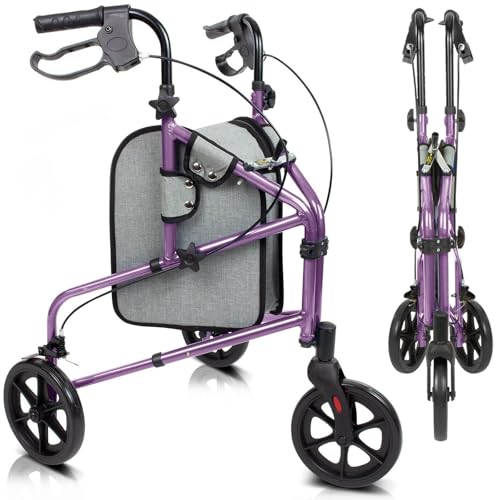
- Three-wheel design helps in small spaces
- Folds for easy car transport
- Includes a removable storage bag
Best For: Adults prioritizing maneuverability and portability
Best Lightweight Adjustable Walker
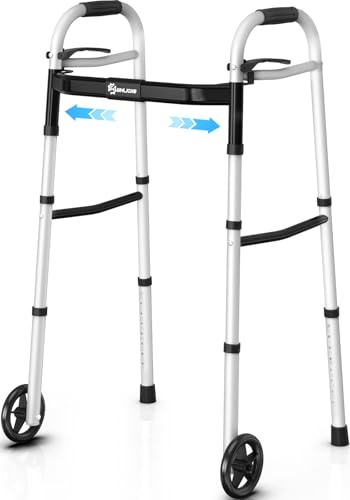
- Weighs only 6.6 pounds
- Adjusts from 22.4 to 26.4 inches wide
- Supports up to 350 pounds
Best For: Travel-minded users with doorways at least 22.5 inches wide
Best Compact Open-Frame Pick – Vive Narrow Folding Walker
For shoppers comparing upright walkers for narrow doorways, the Vive Mobility Lightweight Walker stands out with a compact 26-inch frame and an open rear design. Its 9.5-pound aluminum construction is easy to handle, while adjustable handles and hand brakes support a more personalized fit and controlled movement.
Best For: Adults who need a lightweight walker for small hallways, tight turns, and narrow indoor spaces.
Pros:
- Narrow, space-saving frame is designed for small spaces.
- Open-frame design provides unobstructed walking room.
- Height adjusts from 33 to 39 inches and supports up to 300 pounds.
- Folding design and locking system make it convenient to transport and store.
Cons:
- Its 26-inch width may not suit extremely narrow openings.
- It does not include a seat, tray, or storage compartment.
This is a practical choice when maneuverability and low weight matter more than built-in accessories. The open walking area is especially useful for navigating tight household layouts.
Best Accessory-Rich Indoor Rollator – VOCIC Z32 Narrow Walker
The VOCIC Z32 is a useful option among upright walkers for narrow doorways, with a maximum width of 22 inches and a quick-folding design. Soft 8-inch tires, 360-degree front wheels, and a tray with storage compartments make it suited to everyday apartment use.
Best For: Adults who want a narrow indoor rollator for apartment navigation, carrying items, and quiet movement.
Pros:
- 22-inch maximum width is designed for narrow doorways and apartments.
- Soft PU tires are intended to provide quieter, stable rolling.
- Includes a tray, 17.5-liter mesh compartment, and front and back pockets.
- Five-step handle adjustment reaches up to 41 inches.
Cons:
- At 14.5 pounds, it is heavier than a basic folding walker.
- Its 242-pound weight capacity is lower than some standard walkers.
- Its larger rollator design may be more than needed for users seeking minimal equipment.
The Z32 is a strong fit when storage and rolling convenience are priorities. Its 22-inch width targets tight indoor routes, while the tray and compartments add practicality for household tasks.
Best Lightweight Adjustable Option – Medline Two-Button Folding Walker
Medline Two-Button Folding Walker for Seniors, 5" Wheels, 32.5" to 39.5" Height, 400-lb. Capacity
Check Price On AmazonFor those seeking upright walkers for narrow doorways, this Medline folding walker combines a lightweight 6.5-pound frame with 5-inch wheels and a folding design for transport through tight passages. Its height range of 32 to 39.5 inches supports users who need an adjustable fit.
Best For: Adults who want a simple, lightweight wheeled walker that folds for cars, closets, and narrow routes.
Pros:
- Folds quickly for storage, transportation, and narrow passages.
- Weighs 6.5 pounds for easier handling.
- Five-inch wheels support movement across everyday surfaces.
- Tool-free assembly and textured PVC handgrips add convenience.
Cons:
- The supplied details list a 300-pound capacity, not 400 pounds as suggested by the product title.
- It does not include a seat, tray, or storage basket.
- The 21-inch listed width may be less suitable for exceptionally narrow doorways than narrower models.
This Medline model is a straightforward choice for users who value low weight and easy folding. Measure the doorway first, since its listed 21-inch width still requires adequate clearance.
Best Extra-Narrow Weight Capacity – Delog Adjustable Folding Walker
The Delog Folding Walker is one of the more adaptable upright walkers for narrow doorways, with an adjustable width from 18 to 22 inches. Independent side operation and a trigger-release folding feature can help users manage tight spaces and storage without removing their hands from the handles.
Best For: Adults who need an extra-narrow, height- and width-adjustable walker for small homes, travel, or tight door openings.
Pros:
- Width adjusts from 18 to 22 inches for narrow routes.
- Supports up to 350 pounds while weighing only 6 pounds.
- Independent sides can improve maneuverability and standing stability.
- Height adjusts from 30 to 37 inches in one-inch increments.
Cons:
- As a standard walker, it does not provide wheels, a seat, or storage accessories.
- The narrower configuration may offer a smaller walking base than wider walkers.
- Users should confirm the adjusted width and doorway clearance before purchase.
Its combination of 18-inch minimum width, low weight, and 350-pound capacity makes the Delog particularly compelling for genuinely tight spaces. The adjustable design also helps accommodate different users and room layouts.
Best Narrow Indoor Walker – Motion-Light Folding Walker
If you need upright walkers for narrow doorways, this slim folding model is designed for indoor movement through hallways, bathrooms, and tight entrances. Its fixed wheels, adjustable height, and compact folding frame make it a practical home-mobility option.
Best For: Adults or seniors who want a narrow indoor walker with nighttime lighting, storage, and simple forward movement.
Pros:
- 17-by-19-inch dimensions and a frame designed for narrow indoor spaces.
- Motion-sensor light helps illuminate flooring in low-light conditions.
- Includes a storage bag and folds for transport or compact storage.
- Four quiet 5-inch fixed wheels and a 350-pound maximum capacity.
Cons:
- Fixed wheels are intended for controlled forward movement rather than all-terrain maneuvering.
- Designed primarily for indoor surfaces such as hardwood, tile, and low-pile carpet.
- It does not include a built-in seat for resting.
This is a focused choice for narrow home layouts, especially if low-light visibility and carrying small essentials matter. Check the height range and doorway measurements before ordering.
Best All-Terrain Upright Walker – VOCIC Z22 GelSoft Rollator
Among upright walkers for narrow doorways, the VOCIC Z22 offers flexible steering from a larger rollator platform. Its 360-degree front-wheel system can help in tighter spaces, while the 8-inch wheels are built for gravel, potholes, and slippery surfaces.
Best For: Adults who need an upright rollator with arm support, a seat, and larger wheels for mixed indoor and outdoor terrain.
Pros:
- GelSoft armrests provide cushioned elbow support and help reduce walking impact.
- Flip-out armrests add seat width, and the handle and seat heights are adjustable.
- 8-inch wheels with non-slip tread support outdoor and uneven surfaces.
- Reinforced aluminum frame supports up to 300 pounds and includes ramp-locking brakes.
Cons:
- At 23.2 inches wide and 22.5 pounds, it is less compact than slimmer indoor models.
- Its hand-brake system requires adequate grip strength and upper-body mobility.
- It requires quick assembly before use.
The Z22 is a versatile option when doorway access is important but outdoor capability and seated rest are also priorities. Measure your narrowest doorway carefully, and confirm that the hand brakes suit the user.
Best Compact Rollator – Helavo Narrow Indoor Walker
For shoppers comparing upright walkers for narrow doorways, the Helavo H1031 combines a 23.6-inch width with a lightweight, foldable design. It is intended for quiet indoor rolling and includes a tray for carrying items around the home.
Best For: Adults or seniors in apartments and other indoor settings who want a lightweight rollator with a tray and parking brakes.
Pros:
- 23.6-inch width is designed for tight spaces and doorways.
- Weighs 14.3 pounds and folds to 8.3 by 23.6 by 37.4 inches.
- Height adjusts from 35.4 to 40.2 inches for users from 4 feet 10 inches to 6 feet 2 inches.
- 8-inch wheels roll quietly indoors, while the brake system includes a park function.
Cons:
- Its 240-pound capacity is lower than some heavy-duty walkers.
- The 23.6-inch width may not fit every especially narrow doorway.
- It is designed specifically for indoor surfaces rather than rough outdoor terrain.
This Helavo model is a sensible balance of compact dimensions, low weight, and everyday indoor convenience. Measure doorways and confirm the height range before choosing it for a particular user.
Best Heavy-Duty Narrow Upright Walker – Adjustable Arm-Support Walker
For shoppers comparing upright walkers for narrow doorways, this model stands out for its adjustable 18- to 22-inch width. Its wheels can move inward, creating an 18-inch profile for easier passage through tight indoor spaces, while the reinforced frame supports up to 450 pounds.
Best For: Seniors or bariatric users who need an adjustable-width upright walker with arm support and a high weight capacity.
Pros:
- Five width settings, including an 18-inch narrow configuration.
- Supports up to 450 pounds with a durable H-frame.
- Adjustable 3D PU armrests and sponge handles are designed to reduce wrist and neck fatigue.
- Folds with one touch and assembles without tools.
Cons:
- At 11 pounds, it is heavier than the lightweight Whlicks option.
- Its 42- to 51-inch height range may be taller than needed for some users.
This is the strongest choice here for users who prioritize support, arm positioning, and the narrowest possible doorway clearance. The removable armrests also let it convert to a standard walker mode when preferred.
Best Maneuverable Narrow Rollator – Vive 3-Wheel Folding Walker
If you are looking at upright walkers for narrow doorways but prefer a rolling design, the Vive Mobility 3-wheel walker is built for navigation in small spaces and crowded areas. Its lightweight aluminum frame folds for transport and includes a removable storage bag.
Best For: Adults who want a maneuverable, portable three-wheel rollator for indoor use, travel, and crowded spaces.
Pros:
- Three-wheel design supports maneuverability in small spaces.
- Lightweight, foldable construction is easy to transport in a car.
- Height-adjustable handles help accommodate different users.
- Includes a removable, easy-to-clean storage bag and a lifetime guarantee.
Cons:
- Its 250-pound weight capacity is lower than the other walkers in this roundup.
- The supplied specifications do not state a precise overall width, so doorway fit should be verified before purchase.
The Vive is a practical pick when steering ease and portability matter more than maximum weight capacity. Its three-wheel layout is especially useful for maneuvering through busy or compact areas.
Best Lightweight Adjustable Walker – Whlicks Narrow Folding Walker
For upright walkers for narrow doorways, the Whlicks offers adjustable width from 22.4 to 26.4 inches and a lightweight 6.6-pound frame. Its slim-fit setting requires at least 22.5 inches of clearance, so measure your doors before ordering.
Best For: Seniors who want a lightweight, height- and width-adjustable rolling walker for home use and travel.
Pros:
- Weighs just 6.6 pounds for easier lifting and transport.
- Supports up to 350 pounds with thickened aluminum tubing.
- Height adjusts from 30.3 to 37.4 inches, with a width range of 22.4 to 26.4 inches.
- Five-inch front wheels are designed for smooth indoor and outdoor movement.
Cons:
- Requires at least 22.5 inches of doorway clearance at its slim-fit setting.
- Its narrowest width is greater than the 18-inch setting available on the B0FLJC32S2.
This is the most travel-friendly option in the group, combining a low weight with folding storage and a 350-pound capacity. It is a good fit for users whose doorways meet its stated minimum clearance.
How We Picked These Upright Walkers for Narrow Doorways
We focused on dimensions and features that matter most in compact homes: overall width, folding convenience, wheel design, height adjustment, weight capacity, braking or stability features, and storage options. We also considered whether each walker is better suited to indoor use, occasional outdoor trips, or users who need a seat or more upright posture.
Product specifications can vary by configuration, so check the manufacturer’s listed width, maximum user weight, and adjusted handle height before ordering. A walker that looks narrow in a photo may be wider with a tray, seat, basket, or other accessory attached.
Quick Comparison
- Best for basic compact support: A lightweight two-button or standard folding walker is simple, stable, and easy to store.
- Best for upright positioning: Upright walkers with forearm supports can reduce the need to lean forward, but they require careful height adjustment.
- Best for resting: A seated upright walker or rollator adds a place to pause, though the frame may be heavier or less compact.
- Best for tight turns: Three-wheel walkers can be agile indoors, but they may offer less stability than four-point designs.
- Best for convenience: Models with trays, bags, lights, or quiet wheels can make room-to-room use easier.
Key Buying Factors for Upright Walkers for Narrow Doorways
Measure the Complete Setup
Measure the narrowest doorway, hallway, and turning area in your home. Compare those measurements with the walker’s assembled width, not only its folded size. Leave extra clearance so your hands, elbows, and wheels do not scrape door frames.
Choose Stability Before Compactness
A narrow frame is useful only if it remains stable for the user. Consider wheel size, rear glide tips, locking brakes, and the number of contact points. Users who need substantial weight-bearing support may prefer a conventional folding walker over a highly maneuverable three-wheel model.
Check Fit and Adjustability
Handles or forearm supports should adjust so the user can stand as upright as possible without shrugging or bending excessively. Confirm the height range and make sure the user can operate brakes or buttons comfortably.
Match Features to the Routine
A tray can help carry meals, while a storage bag keeps personal items accessible. A seat is valuable for rest breaks but adds weight and may change the walker’s balance. Motion-sensor lighting can help with nighttime navigation, but it should supplement—not replace—adequate home lighting.
Who Should Buy Which Upright Walkers for Narrow Doorways?
Choose a lightweight folding walker if you primarily need stable indoor support and want easy storage or transport. Choose an upright model if posture, forearm support, or reduced forward bending is a priority. Choose a seated rollator if frequent rest stops are part of the day and there is enough room to maneuver. Choose a three-wheel walker if turning space is especially limited and the user can safely manage its different handling characteristics.
Before use, have the walker adjusted by a qualified clinician or mobility specialist when possible. Practice braking, folding, and turning on a clear surface, and confirm that the selected model’s capacity and dimensions suit the intended user and home.