When bending your forefoot hurts, a rigid insert can limit shoe flex without requiring a completely different pair of shoes. But the right choice depends on more than the carbon fiber label: plate length, thickness, sizing, and the space inside your shoe all matter.
These 10 options include full-length plates, Morton’s extensions, thin inserts, and activity-oriented designs. Use the guide below to narrow down the style that fits your footwear and the support you need.
Best 10 Carbon Fiber Shoe Inserts Picks for 2026
Best Full-Length Rigid Pair
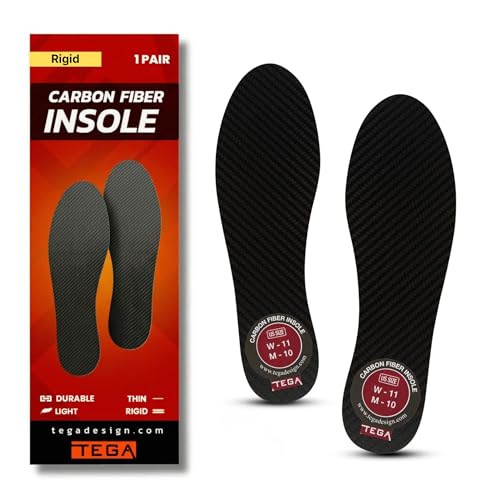
- Sold as a pair
- Thin 1.3 mm rigid construction
- No built-in arch support
Best For: Limiting overall shoe flex in both shoes
Best Big-Toe Support in W11/M10

- Women's 11 / men's 10 listing
- Right-and-left pair
- Limits big-toe joint motion
Best For: Targeted big-toe support in the W11/M10 size range
Best Big-Toe Support in W8/M7
- Women's 8 / men's 7 listing
- Right-and-left pair
- Targeted big-toe rigidity
Best For: Targeted big-toe support in the W8/M7 size range
Big-Toe Motion Control
Morton's Extension Carbon Fiber Pair
- Right-and-left pair
- Limits big-toe joint motion
- Thin 3K carbon fiber
Best For: Rigid big-toe support for hallux conditions or turf toe
Athletic-Shoe Foot Plate

- Rigid 1.3 mm plates
- Fits beneath existing insoles
- For sneakers and athletic shoes
Best For: Adding stiffness beneath insoles in athletic footwear
Measured-Fit Sports Pair
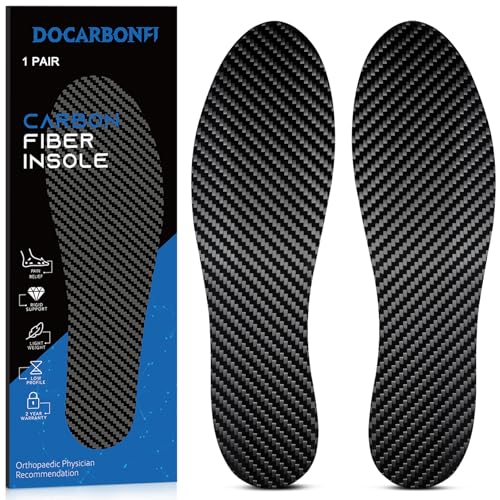
- Two reversible plates
- Slim 1.3 mm profile
- Measure for 0.4–0.6 inch clearance
Best For: Measured-fit stiffness in sneakers or sports shoes
Easy Sizing
1.3mm Rigid Carbon Fiber Insole Pair

- Full-length plates limit forefoot bending
- Measure removable insole without subtraction
- Needs roomy shoes with removable insoles
Best For: Rigid forefoot support with straightforward sizing
Large-Size Pair
12.01-Inch Carbon Fiber Insoles

- Pair listed for men’s sizes 14–14.5
- Rigid, lightweight 1.2mm plates
- Allow 0.4–0.6 inches of fit clearance
Best For: Larger shoes with removable insoles
Titanium-Enhanced
275mm Carbon Fiber Insole Pair

- Titanium-enhanced, rigid 1.2mm design
- Reversible pair fits beneath original insoles
- Choose 1/4–1/2 inch shorter than insoles
Best For: Athletic shoes with removable insoles
Best Full-Length Rigid Pair – TEGA Carbon Fiber Insoles
For shoppers comparing carbon fiber shoe inserts to reduce shoe bending, this TEGA pair offers thin, rigid support across the foot. The 1.3 mm inserts are made from 3K carbon fiber and are intended for conditions including turf toe and hallux rigidus.
Best For: People who want a rigid pair for both shoes rather than a targeted big-toe extension.
Pros:
- Sold as a left-and-right pair.
- Thin, lightweight construction helps limit bending.
- Suitable for sneakers and sports shoes.
Cons:
- No built-in arch support.
- Requires measuring your existing insoles against the size chart.
Choose these when limiting overall shoe flex matters more than cushioning or arch support. Check the insole length before ordering.
Best Cushioned Sport Option – XEPXEP Carbon Fiber Sport Insole
Among carbon fiber shoe inserts, this XEPXEP option takes a cushioned approach: it combines carbon fiber with PU foam, a medium arch, and a breathable mesh surface. It is marketed for basketball and running shoes rather than as a thin, fully rigid insert.
Best For: Active shoppers who want arch support and foam cushioning alongside carbon fiber.
Pros:
- PU foam adds shock absorption.
- Medium-arch design provides shaped support.
- Mesh surface is designed for airflow and sweat absorption.
- Listed with a one-year warranty and a 90-day refund or replacement option.
Cons:
- Not the same low-profile, rigid design as a carbon fiber plate.
- Specific speed and jump improvements are seller claims, not guaranteed results.
Pick this for a more padded sport-insole feel; look to a rigid insert instead if your priority is restricting toe-joint motion.
Best Big-Toe Support in W11/M10 – Morton's Extension Orthotic
If you need carbon fiber shoe inserts focused on the big toe joint, this Morton’s extension pair is designed to limit that joint’s motion. This listing is sized for women’s 11 or men’s 10 shoes, but the maker recommends checking your original insole length against its chart.
Best For: Shoppers in the W11/M10 size range seeking a rigid big-toe extension for turf toe, hallux limitus, or hallux rigidus.
Pros:
- Includes right- and left-foot extensions.
- Thin, lightweight 3K carbon fiber construction.
- Targeted design limits big-toe joint motion.
Cons:
- Targeted extension is not a full-foot rigid insole.
- Fit depends on matching your existing insole length to the size chart.
This is the more focused choice when big-toe motion is the concern. Confirm sizing carefully rather than relying on shoe size alone.
Best Big-Toe Support in W8/M7 – Morton's Extension Orthotic
These carbon fiber shoe inserts are Morton’s extensions rather than full-foot plates. Sold as a right-and-left pair in the women’s 8/men’s 7 listing, they are designed to restrict big-toe joint movement during walking, standing, or sports.
Best For: Shoppers in the W8/M7 size range who want targeted rigidity for the big toe joint.
Pros:
- Two extensions support both feet.
- Thin, lightweight 3K carbon fiber construction.
- Designed for concerns including turf toe and hallux rigidus.
Cons:
- Does not provide the coverage of a full-length rigid plate.
- Requires checking the original insole length against the size chart.
Consider this size-specific pair when you need to limit big-toe flex without choosing a full-foot insert. Measure before buying to verify the fit.
Big-Toe Motion Control – Morton's Extension Carbon Fiber Pair
These carbon fiber shoe inserts are shaped as Morton’s extensions to limit motion at the big-toe joint. This listing is for a right-and-left pair in women’s 13–13.5 / men’s 12–12.5.
Best For: Shoppers seeking rigid big-toe support for hallux limitus, hallux rigidus, or turf toe.
Pros:
- Includes one insert for each foot.
- Thin, lightweight construction made from genuine 3K carbon fiber.
- Designed for daily wear or sports activities.
Cons:
- Rigid design is intended to restrict big-toe motion, not provide a flexible feel.
- Choosing the correct size requires measuring your shoe’s original insole.
Choose this pair when limiting big-toe movement is the priority; check your removable insole length against the size chart before ordering.
Athletic-Shoe Foot Plate – Thin 1.3 mm Carbon Fiber Pair
These carbon fiber shoe inserts use a flat, 1.3 mm rigid plate to reduce shoe bending and limit excess foot movement. The specified option is a pair sized for men’s 10–10.5 / women’s 11–11.5.
Best For: Wearers who want a stiff plate beneath existing insoles in sneakers or athletic shoes.
Pros:
- Slim carbon fiber plates fit beneath original insoles or orthotic inserts.
- Each plate can be flipped to fit either foot.
- Designed for athletic footwear, including sneakers and sports cleats.
Cons:
- Not intended for dress shoes or high heels.
- Requires careful sizing: the plate should be ¼–½ inch shorter than the original insole.
This is a practical option if you already have a comfortable top insole and want to add stiffness underneath it. Confirm both shoe compatibility and insole length before buying.
Measured-Fit Sports Pair – Flat Carbon Fiber Foot Plates
These carbon fiber shoe inserts come as a pair of thin, flat plates intended to stiffen athletic footwear beneath its removable insoles. The supplied details specify a 9.65-inch / 245 mm option; check the size chart and your insole measurements rather than relying on shoe size alone.
Best For: Shoppers who want rigid plates for sneakers, hiking boots, or other athletic shoes and can measure for fit.
Pros:
- Includes two reversible plates that can fit either foot.
- 1.3 mm thickness adds stiffness with a slim profile.
- Designed for use in a range of sports and athletic shoes.
Cons:
- Not suited to dress shoes or high heels.
- Plates should be 0.4–0.6 inch shorter than the shoe’s removable liners, so measuring is important.
The appeal here is a low-profile, rigid under-insole plate. Check the listed length against the liners in the shoes you plan to wear it with.
Easy Sizing – 1.3mm Rigid Carbon Fiber Insole Pair
These carbon fiber shoe inserts are a practical choice if you want a firm, full-length plate that limits forefoot and big-toe bending. The slim 1.3mm pair sits beneath your shoes’ removable insoles.
Best For: Shoppers seeking rigid forefoot support and straightforward sizing for roomy everyday shoes.
Pros:
- Rigid, full-length design helps limit motion at the big toe and forefoot.
- Sizing uses the measured length of your removable shoe insole, with no subtraction required.
- Lightweight 3K twill-weave carbon fiber fits beneath the original insole.
Cons:
- Requires a removable insole, a flat footbed, and adequate shoe space.
- Narrow, pointed-toe, high-heel, or fixed-insole shoes may not accommodate the plates.
The simple measurement method distinguishes this pair from inserts that require you to calculate a shorter plate length. For injury or post-op use, check with a healthcare professional first.
Large-Size Pair – 12.01-Inch Carbon Fiber Insoles
For shoppers needing larger carbon fiber shoe inserts, this pair is listed at 12.01 inches for men’s sizes 14–14.5. Each thin, rigid 1.2mm plate goes beneath the shoe’s original removable insole.
Best For: Wearers of men’s size 14–14.5 shoes who want a pair of rigid under-insole plates.
Pros:
- Sold as a pair rather than a single plate.
- Thin, lightweight carbon fiber construction adds firm structure.
- Designed to sit beneath removable insoles for walking or other activities.
Cons:
- Requires measuring your removable insoles and allowing roughly 0.4–0.6 inches of clearance.
- Rigid plates do not replace the cushioning of your original insoles.
The stated 12.01-inch length makes this option worth checking for larger shoes, but verify your insole measurements before ordering. Ask your doctor whether rigid plates suit your foot concerns.
Titanium-Enhanced – 275mm Carbon Fiber Insole Pair
These carbon fiber shoe inserts pair a rigid 1.2mm design with a titanium-enhanced layer. The 275mm pair is intended to sit beneath removable insoles in athletic shoes and other compatible footwear.
Best For: Active shoppers interested in a titanium-enhanced rigid plate for shoes with removable insoles.
Pros:
- Sold as a pair of reversible plates that can fit either foot.
- Thin construction is designed for use beneath original insoles.
- Listed for athletic footwear including sneakers and hiking boots.
Cons:
- Plates should be 1/4–1/2 inch shorter than the removable insoles, so sizing takes care.
- Not intended for high heels or flip-flops.
Choose this pair for its titanium-enhanced construction and athletic-shoe compatibility, rather than relying on the listing’s quantified injury-prevention claims. Confirm the 275mm length against your removable insoles before buying.
How We Picked These Carbon Fiber Shoe Inserts
We focused on practical differences buyers can check before ordering: full-length versus partial-length coverage, stated thickness, size options, whether an insert is sold as a pair, and the intended use described in each listing. Several options have nearly identical names, so check the exact size and configuration rather than relying on the product title alone. We did not treat claims about turf toe, fractures, or arthritis as proof that an insert will treat those conditions.
Quick Comparison: Which Style Fits Your Needs?
Full-length rigid plates are the starting point if you want to reduce bending across more of the forefoot. Morton’s extensions target the big-toe side rather than covering the entire forefoot in the same way. Thin plates, including the listed 1.3 mm option, may be easier to fit in lower-volume shoes, though thickness alone does not establish how stiff an insert will feel. Performance-oriented options may appeal to active buyers, but shoe compatibility and comfort still matter more than the label.
Key Buying Factors
Coverage and the Amount of Motion You Want to Limit
Choose a plate shape based on where you need rigidity. A full-length insert affects how the shoe bends over a broader area; a Morton’s extension concentrates support beneath the big toe. If a clinician has recommended a particular plate style or degree of restriction, follow that guidance rather than choosing by product name.
Size, Shoe Volume, and Edges
Check the manufacturer’s length chart against your foot and the shoe you plan to use—not just your usual shoe size. A plate that is too long can bunch up or press against the toe box; one that is too short may sit in the wrong place. Rigid carbon fiber generally cannot be trimmed like a foam insole. Check whether the insert goes under your existing insole and whether your shoe has enough room to accommodate both without crowding your toes.
Thickness, Stiffness, and What’s Included
Thickness can affect fit, but it is not a reliable stiffness rating across different constructions. Look for a stated thickness when shoe space is limited, and check whether the listing specifies one insert or a pair. Some listings specify a length in millimeters; compare that measurement with the intended shoe, especially when ordering across men’s and women’s size ranges.
Who Should Buy Which Carbon Fiber Shoe Inserts?
Start with a full-length plate if you want broad forefoot rigidity and have room in your shoe. Consider a Morton’s extension if your goal is more targeted big-toe support and that shape matches your clinician’s recommendation. Try a thinner option when fit is the main obstacle, but do not assume it will deliver the same feel as a thicker plate. For sports or hiking, check the insert in the actual shoes you will wear before committing to a long outing.
Carbon Fiber Shoe Inserts provide rigidity, not cushioning. If you have a suspected fracture, persistent pain, or worsening symptoms, seek medical advice; an insert is not a substitute for diagnosis or prescribed immobilization.