After back surgery, getting into and out of a chair can be harder than settling into one. A power lift recliner may reduce the effort of standing, while adjustable positions can help you find a more comfortable way to rest.
The right choice depends on your surgeon’s movement restrictions, your height, and the support you need—not just the number of comfort features. These 10 chairs offer different lift mechanisms, sizes, and positioning options to compare.
Best 10 Back Surgery Recliner Chair Picks for 2026
Best With a Tray
Dual-Motor Leather Lift Recliner

- Independent backrest and footrest
- Foldable tray with wireless charger
- 400-pound stated capacity
Best For: Stand assistance with essentials close at hand
Best Power-Switch Option
JIKFRIMA Dual-Motor Lift Recliner

- Independent back and foot controls
- Rear switch cuts chair power
- Foldable charging tray
Best For: Adjustable reclining with an easy power-off switch
Best Headrest Control
MCombo 3-Motor Power Lift Recliner

- Three independent powered sections
- 165-degree recline and power lift
- Five size options
Best For: Fine-tuning head, back, and leg positions
Best Simple Stand Assist
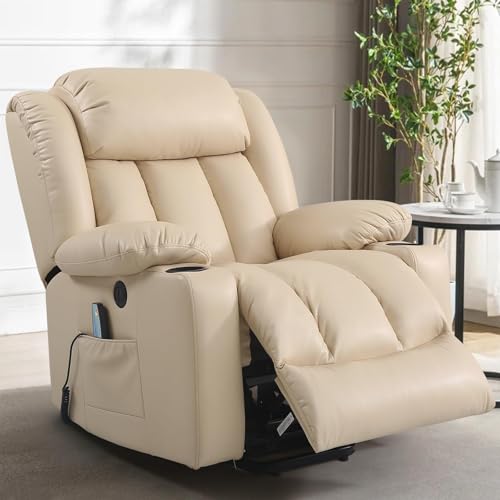
- Armrest-button power lift
- 160-degree recline
- Wipe-clean PU leather
Best For: Straightforward lift operation and easy cleaning
Flexible Positioning
Trustyue Dual-Motor Lift Recliner

- Independent backrest and footrest controls
- Reclines to 180° and assists standing
- Vibration massage and lumbar heat
Best For: Flexible positioning with powered standing assistance
Easy-Care Pick
MCombo 7040 Power Lift Recliner

- Wipe-clean faux leather upholstery
- Powered lift with 140° maximum recline
- Cup holders, pockets, and low-power USB outlets
Best For: Easy cleaning and within-reach conveniences
Soft-Fabric Option
EZZUP Dual-Motor Lay-Flat Recliner

- Chenille upholstery and foam cushioning
- Independent controls and 180° recline
- Powered lift and two side pockets
Best For: Soft fabric with flexible reclining positions
Simple Lift Pick
MCombo Large Fabric Power Lift Recliner

- Quiet powered lift and 150° recline
- Extended footrest and built-in conveniences
- No massage or heat
Best For: Straightforward lift assistance without extra therapy features
Most Adjustable
Triple-Motor Lay-Flat Lift Recliner

- Independent head, back, and footrest controls
- Lay-flat design and extended footrest
- Five massage modes plus waist heat
Best For: Roomy seating with highly adjustable positioning
Plush Comfort Pick
CANMOV Large Power Lift Recliner

- Power lift with 110–150° recline
- Five massage modes and lumbar heat
- Plush upholstery with pockets and cup holders
Best For: A cushioned lift chair with relaxation features
Best With a Tray – Dual-Motor Leather Lift Recliner
If you want a back surgery recliner chair that helps you stand and keeps essentials close, this model combines a power lift with a foldable tray. Its two motors let you adjust the backrest and footrest separately, including a fully reclined position. Check your surgeon’s positioning guidance before using that position during recovery.
Best For: Shoppers who want independent positioning, stand assistance, and a built-in surface for drinks or devices.
Pros:
- Independent backrest and footrest controls, plus a power lift.
- Foldable tray has a cup holder and wireless charger; USB and Type-C ports are also included.
- Removable lumbar pillow, extended footrest, and 400-pound stated weight capacity.
Cons:
- Ships in three packages, with the heaviest listed at 83 pounds; arrange help bringing them inside.
- Separate remotes for reclining and massage add another control to keep track of.
The tray sets this chair apart if you expect to spend long stretches seated. Heat and vibration massage are comfort extras, not substitutes for your clinician’s recovery instructions.
Best Power-Switch Option – JIKFRIMA Dual-Motor Lift Recliner
This back surgery recliner chair option offers a power lift and separate backrest and footrest adjustment, useful when you need to fine-tune how you sit or rest. The JIKFRIMA also reclines fully and has a rear power switch that cuts power without unplugging the chair. Follow your surgeon’s advice on when and how far to recline.
Best For: Buyers who want independent positioning and a convenient switch for turning off chair power.
Pros:
- Two motors independently adjust the backrest and footrest.
- Foldable side tray includes a cup holder and wireless charger.
- Detachable lumbar pillow and extended footrest add positioning options.
Cons:
- Ships in three packages, with the heaviest listed at 89 pounds.
- Lift and massage use separate remotes, which may be less convenient to manage.
The power switch is a practical distinction if you prefer not to reach for an outlet between uses. Its vibration massage and lumbar heat are optional comfort features rather than recovery treatments.
Best Headrest Control – MCombo 3-Motor Power Lift Recliner
For a back surgery recliner chair with more ways to adjust your resting position, the MCombo uses three motors to control its headrest, backrest, and footrest independently. It also has a power lift and reclines to 165 degrees—nearly flat, but not fully flat. Confirm suitable positions with your care team after surgery.
Best For: People who want powered head support as well as separate back and leg positioning.
Pros:
- Independent headrest, backrest, and footrest adjustments.
- Available in five sizes, with a 4.7-inch extended footrest listed for this model.
- Separate lumbar and seat heating can be used independently of vibration massage.
- Includes a two-year limited manufacturer warranty.
Cons:
- Its 165-degree recline is nearly flat rather than fully flat.
- Ships in three boxes; the listed large chair weighs 128.3 pounds.
The powered headrest is the clearest reason to choose this chair over a two-motor option, especially for reading while reclined. Check the dimensions of your chosen size before ordering.
Best Simple Stand Assist – PARKOL Power Lift Recliner
If your priority in a back surgery recliner chair is getting up with less effort, the PARKOL offers a power lift operated by an armrest button. Its single motor also reclines the chair to 160 degrees for resting. Ask your surgeon which seated and reclined positions are appropriate for your recovery.
Best For: Shoppers who prioritize straightforward lift operation and easy-clean upholstery.
Pros:
- Armrest button operates the stand-assist lift.
- Water-resistant PU leather can be wiped clean.
- Includes lumbar heat, eight-point vibration massage, cup holders, side pockets, and a USB port.
Cons:
- A single motor does not offer the independent backrest and footrest control of multi-motor chairs.
- The 160-degree recline does not lie flat.
- Stated maximum weight recommendation is 300 pounds.
This is a simpler choice when standing assistance matters more than precise positioning. Measure your space for the listed 38-by-38-inch footprint, and treat the heat and massage as comfort features.
Flexible Positioning – Trustyue Dual-Motor Lift Recliner
If you’re shopping for a back surgery recliner chair, the Trustyue is worth considering for its independently adjustable backrest and footrest. It reclines to 180° and has a powered lift to help with standing, but check with your care team about appropriate positions during recovery.
Best For: Adults who want flexible reclining positions and standing assistance in a chenille chair.
Pros:
- Dual motors adjust the backrest and footrest independently.
- Lift mechanism raises the chair; a HOME button returns it upright.
- Includes eight-point vibration massage, lumbar heat, and a 350-pound weight limit.
Cons:
- Massage is vibration-based, not a kneading massage.
- Ships in two boxes and requires some assembly.
The independent controls are the main draw if a single fixed recline path feels limiting. Its 29.1-inch overall width is worth checking against your available space before ordering.
For a back surgery recliner chair with easy-to-clean upholstery, the MCombo 7040 pairs a powered lift with wipe-clean faux leather. Its two-button remote adjusts the chair between lift and recline positions; its maximum recline is 140°, rather than lay-flat.
Best For: Shoppers within the recommended 5’1″–5’9″ height range who prioritize easy cleaning and convenient armrest storage.
Pros:
- Counterbalanced lift mechanism assists with standing.
- Eight vibration points and lumbar heat have timed shutoffs; heat works separately.
- Includes cup holders, side pockets, and two USB outlets for low-power devices.
- Supports up to 350 pounds and includes a two-year limited warranty.
Cons:
- Maximum 140° recline will not suit shoppers seeking a flat position.
- Recommended for users 5’1″–5’9″ tall.
This is the practical pick when cleanup and keeping essentials close matter more than fully flat reclining. Confirm your clinician’s positioning guidance before using any recliner after surgery.
If a soft fabric surface matters in a back surgery recliner chair, this EZZUP model offers chenille upholstery, independent backrest and footrest controls, and a 180° recline. Its powered lift can assist with standing, while side pockets keep small items nearby.
Best For: Shoppers who prefer breathable chenille and want lay-flat positioning with independent controls.
Pros:
- Dual motors let you adjust the backrest and footrest separately.
- Reclines to 180° and has a lift function with a HOME button.
- Includes eight vibration nodes, three massage modes, optional lumbar heat, and two side pockets.
Cons:
- Chenille may take more care to clean than wipe-clean faux leather.
- The supplied dimensions appear inconsistent, so verify the chair’s footprint before buying.
The combination of position control and accessible storage may be useful when you want to minimize reaching. Follow your surgical team’s guidance on reclining and standing during recovery.
Simple Lift Pick – MCombo Large Fabric Power Lift Recliner
If you’re comparing a back surgery recliner chair, this MCombo model offers powered lift assistance without massage or heat controls. Its 150° recline and extended footrest give you room to adjust your resting position.
Best For: Shoppers who want a straightforward lift chair with everyday conveniences and no massage or heat.
Pros:
- Quiet power lift helps with sitting down and standing up.
- 150° recline and 4.7-inch extended footrest provide more room to stretch out.
- Two cup holders, USB and Type-C ports, and storage pockets keep essentials close.
- No-tool assembly is estimated at about 15 minutes; a two-year limited manufacturer warranty is included.
Cons:
- No massage or heating functions.
- Ships in three boxes and requires assembly.
The simplified controls may appeal if lift assistance is your priority. Check the 20.5-inch seat height and 22-inch seat depth against your needs, and follow your surgeon’s guidance on reclining and standing after surgery.
Most Adjustable – Triple-Motor Lay-Flat Lift Recliner
For someone shopping for a back surgery recliner chair who wants more positioning options, this triple-motor model independently adjusts the headrest, backrest, and footrest. Its lay-flat design and power lift provide alternatives to a standard fixed-position recliner.
Best For: Buyers prioritizing independent position adjustments, a roomy seat, and built-in heat and massage.
Pros:
- Separate motor controls allow personalized head, back, and leg positioning.
- Wide seat, padded backrest, and 4.7-inch extended footrest offer ample space.
- Includes five massage modes and waist heating.
- Rated for a maximum weight of 360 pounds.
Cons:
- At 40 inches wide and 136 pounds, it needs adequate space and help with moving.
- Faux-leather upholstery may not suit shoppers seeking fabric.
The independent controls are the main reason to consider this chair. Ask your care team which positions—and whether heat or massage—are appropriate during your recovery.
Plush Comfort Pick – CANMOV Large Power Lift Recliner
This CANMOV option pairs power lift assistance with a plush, wide seat for shoppers considering a back surgery recliner chair. Its 110–150° powered recline gives you several resting angles, while the side-button lift helps with getting up.
Best For: Buyers seeking a cushioned lift recliner with massage, lumbar heat, and nearby storage.
Pros:
- Power lift and 110–150° recline are controlled from a side button.
- Massage covers the back, lumbar area, thighs, and legs, with five modes and timer settings.
- Two lumbar heat points, side pockets, concealed cup holders, and USB charging add convenience.
- No-tool assembly and a one-year warranty are listed.
Cons:
- USB charging is specified for low-power devices only.
- The listed seat dimensions conflict: the description cites a 20.9-inch depth, while the details list 25 inches. Confirm the fit before buying.
This is a feature-rich choice if you prefer soft upholstery and powered help standing. Confirm seat measurements and check with your clinician before using recline, heat, or massage after surgery.
How We Picked the Best Back Surgery Recliner Chair
We focused on features that matter when choosing a Back Surgery Recliner Chair: powered standing assistance, adjustability, seat dimensions, accessible controls, and practical upholstery. This shortlist includes single-, dual-, and triple-motor options so you can compare simpler operation with more independent positioning. We did not treat heat or massage as recovery benefits; ask your care team before using either feature after surgery.
Quick Comparison: Which Type Fits Your Needs?
- Single-motor lift recliners: Often the simplest to operate, but the backrest and footrest may move together. Check the exact model’s controls and positions.
- Dual-motor models: Typically offer more independent back and footrest adjustment, which may make it easier to find a position that follows your care instructions.
- Triple-motor models: Add another adjustment to consider if fine-tuning matters to you. Confirm what each motor controls rather than assuming all models work alike.
- Large or wide chairs: Worth considering if standard seats feel cramped, provided the seat height and depth still let you sit securely and place your feet where instructed.
Key Buying Factors for a Back Surgery Recliner Chair
Fit and Safe Transfers
Measure the user and the space before comparing extras. Check seat height, width, and depth, armrest height, weight capacity, and the clearance needed to recline. A seat that is too deep or too high can make standing and sitting more awkward. Ask your physical therapist or surgeon whether a lift chair is appropriate and how to use it without breaking bending, lifting, or twisting precautions.
Positioning and Controls
Look for a lift motion that brings you to a controlled standing position and a remote you can reach and understand easily. If your instructions call for a particular sitting or resting posture, verify the chair can achieve it; a “lay-flat” label alone does not establish that it is suitable for post-surgical recovery. Consider what happens during a power outage, and check whether the model includes battery backup or requires a separate purchase.
Comfort, Setup, and Extras
Supportive padding and a fabric that is easy for you to maintain may matter more day to day than built-in massage. Review assembly requirements, doorway dimensions, delivery options, warranty terms, and return costs before ordering. If you expect to sleep in the chair, get medical guidance on positioning rather than assuming reclining is safer than a bed.
Who Should Buy Which Back Surgery Recliner Chair?
Choose a straightforward lift chair if easy controls and standing assistance are your priorities. Consider a dual- or triple-motor chair if your care plan permits reclining and you need more precise adjustments. If you need extra room, compare the large MCombo, CANMOV, and triple-motor options against your measurements; if you want a medium-size option, check the MCombo 7040’s dimensions. Whichever you choose, prioritize your clinician’s instructions and a secure fit over heat, massage, or USB ports.